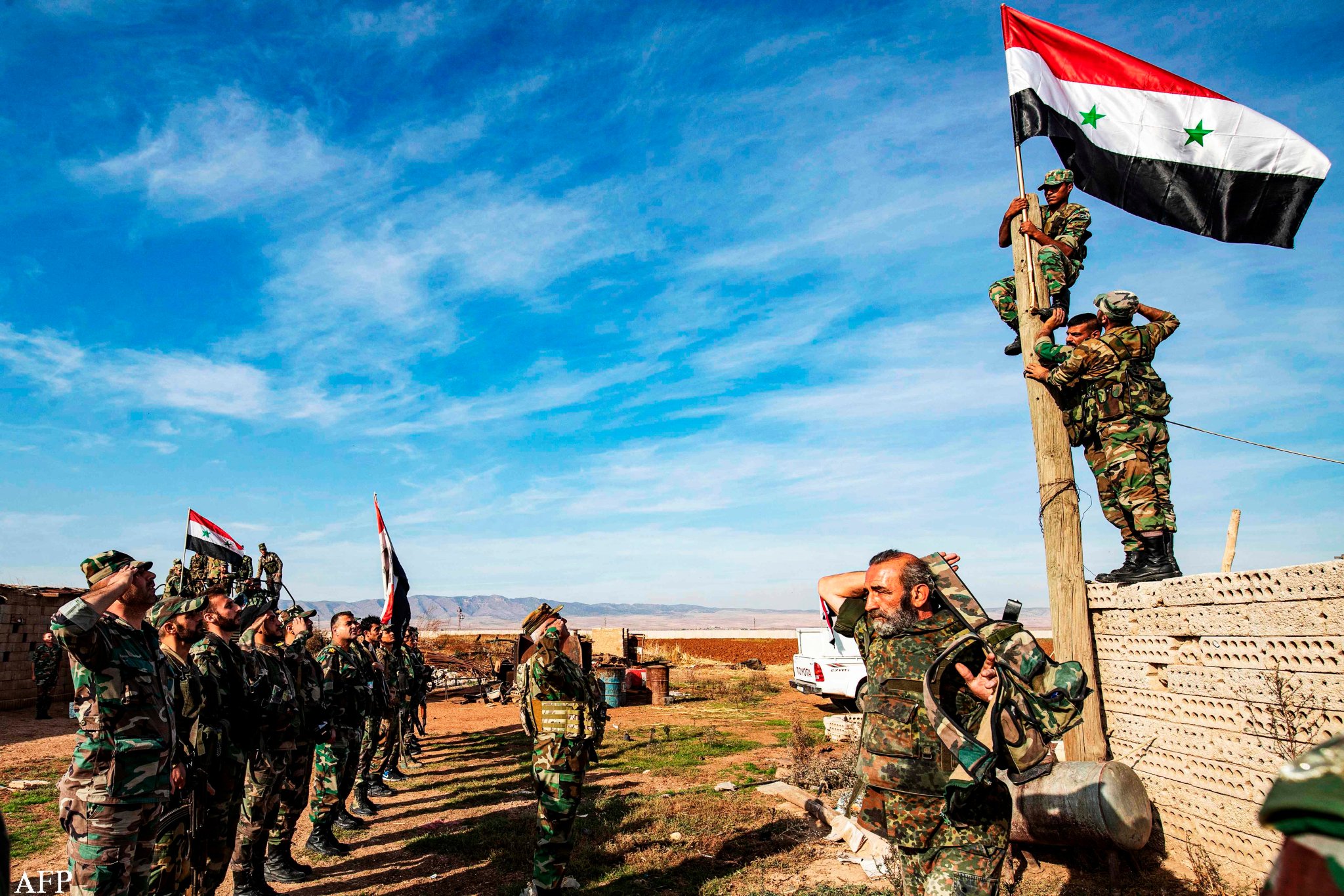
Nov 10 (3/7): Tal Tamr: It’s On.

It’s on.

Progressive Maps (3 days)

So it’s on. Whatever it is.

26726

26725

There is chatter among Turkish backed milita (both SNA to the west and TFSA to the east) about gathering around Kobanî for something. Including those forces, SAA to the south, and the Turkish border to the north, many residents feel surrounded in  Kobanî. Plus: Russians.

Kobanî & Manbij are the strategic points in that region. Also worth noting: Kobani holds enormous local significance as the Kurds’ first real defeat of ISIS. It’s already part of Rojavan lore.

Nov 10 (2/7): Seating is Fluid

US military continues unpredictable behavior.

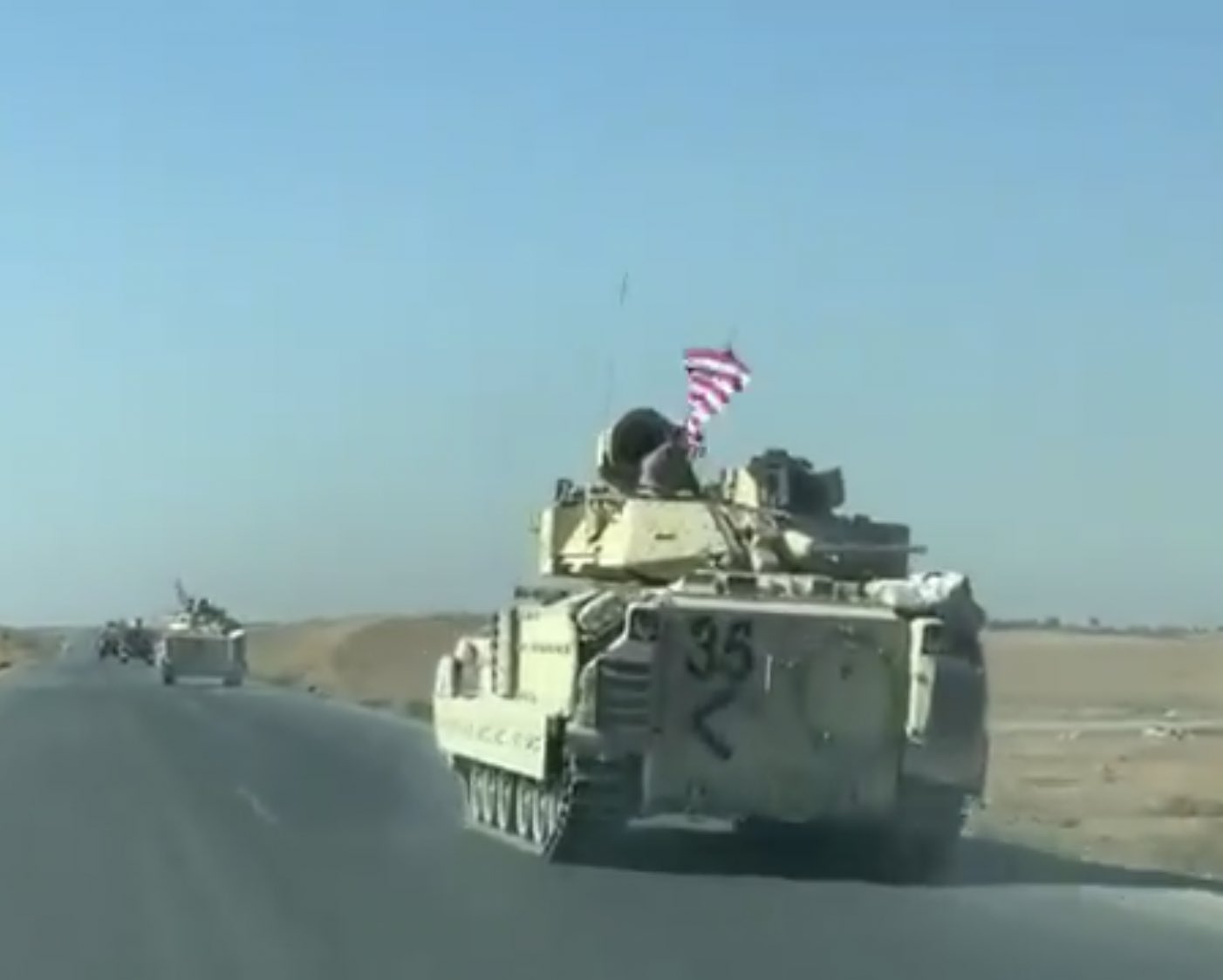
Reports that after the ~40 vehicle convoy traveled from Qamishli to a base (bases?) near Manbij, the US didn’t leave.

Also, they brought Bradleys, allegedly out of concern of being attacked by Turkish backed FSA.

Nobody believes the reasons given for the Bradleys. Not the press, not the locals.


Bradleys in convoy:

Observers in the media have pointed out Bradleys were an odd choice for defending Deir ez-Zur, seeing as the concern was guerillas and, anyway, they and SDF has never needed them to protect the region before; air strikes were sufficient to dissuade artillery in the mountains.

The military has claimed this gives the forces greater mobility, flexibility, etc.. (Also, Rear Adm. Byrne said, at the end of the day, they’re really good and the commander in the region wanted them.)

Observers on he ground are pointing out that Bradleys are a suspect choice for highway patrol.

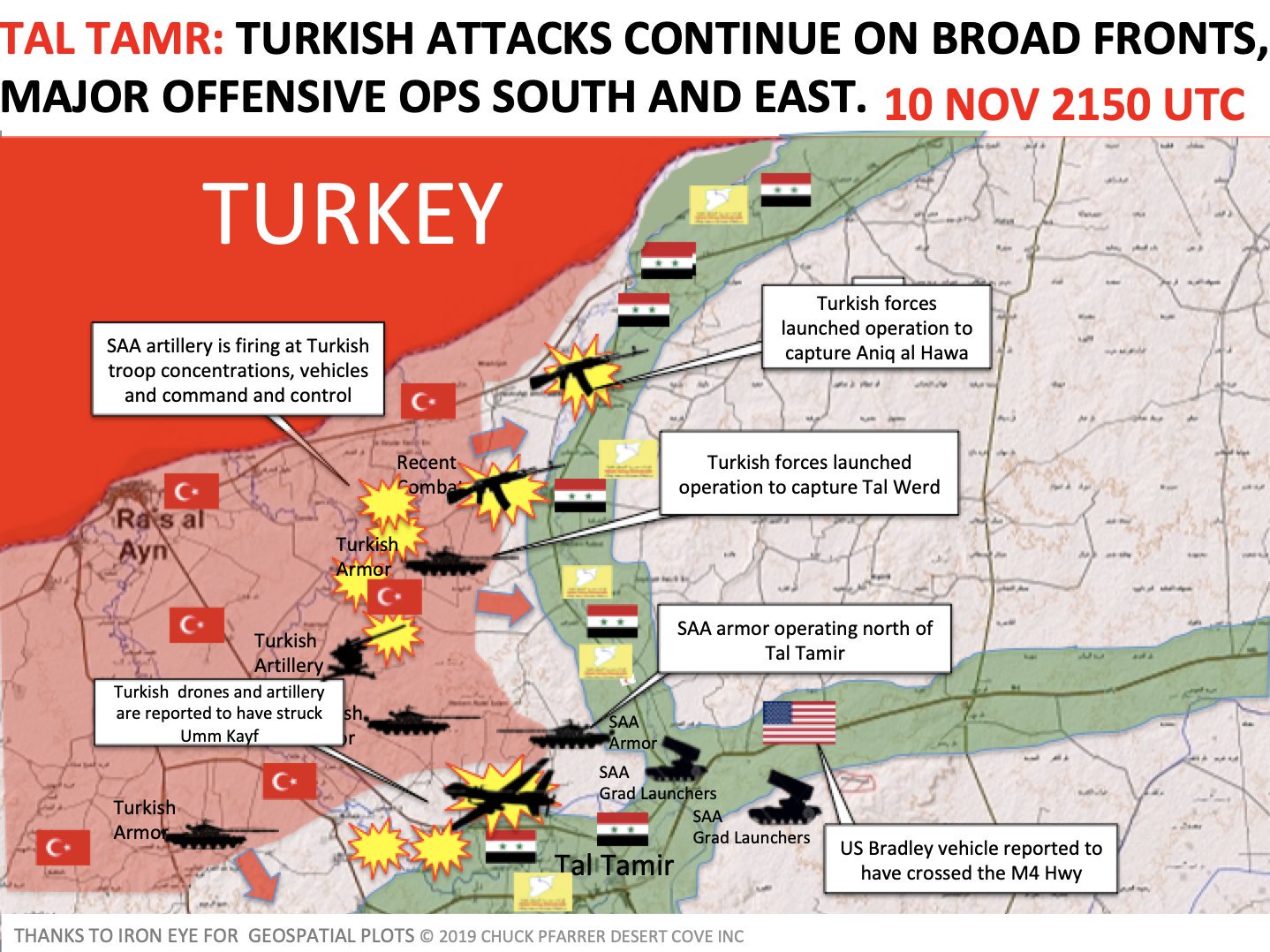
Meanwhile, US has patrols near Tall Tamr in Hossakah province province amidst heavy fighting including AH-64 Apache helicopters.

Why? Everyone is sure they have their reasons. Possibly to protect the M4? Unusually large force, especially since nobody is supposed to be shooting at them. The fighting seems intense, though, so maybe that’s why.

So the situation on the ground is… fluid.

Since the first withdrawals, any time US announces troop withdrawal, we redeploy and become more engaged.

So, well, I guess… These colors don’t run?

Nov 10 (1/7): Ground Update: Qamishli Bombing

West to east.

Idlib:

Same as always. If it’s happening anywhere—artillery, air strikes, ground battles, all of it—it’s happening there.

TheNewArab: Assad has threatened to obliterate Idlib with Russia’s help. Can Turkey stop him?

SouthFront: IN VIDEO: TURKISH-BACKED MILITANTS SHELL ARMY POSITIONS IN SOUTHEASTERN IDLIB

Kobani/Manij:

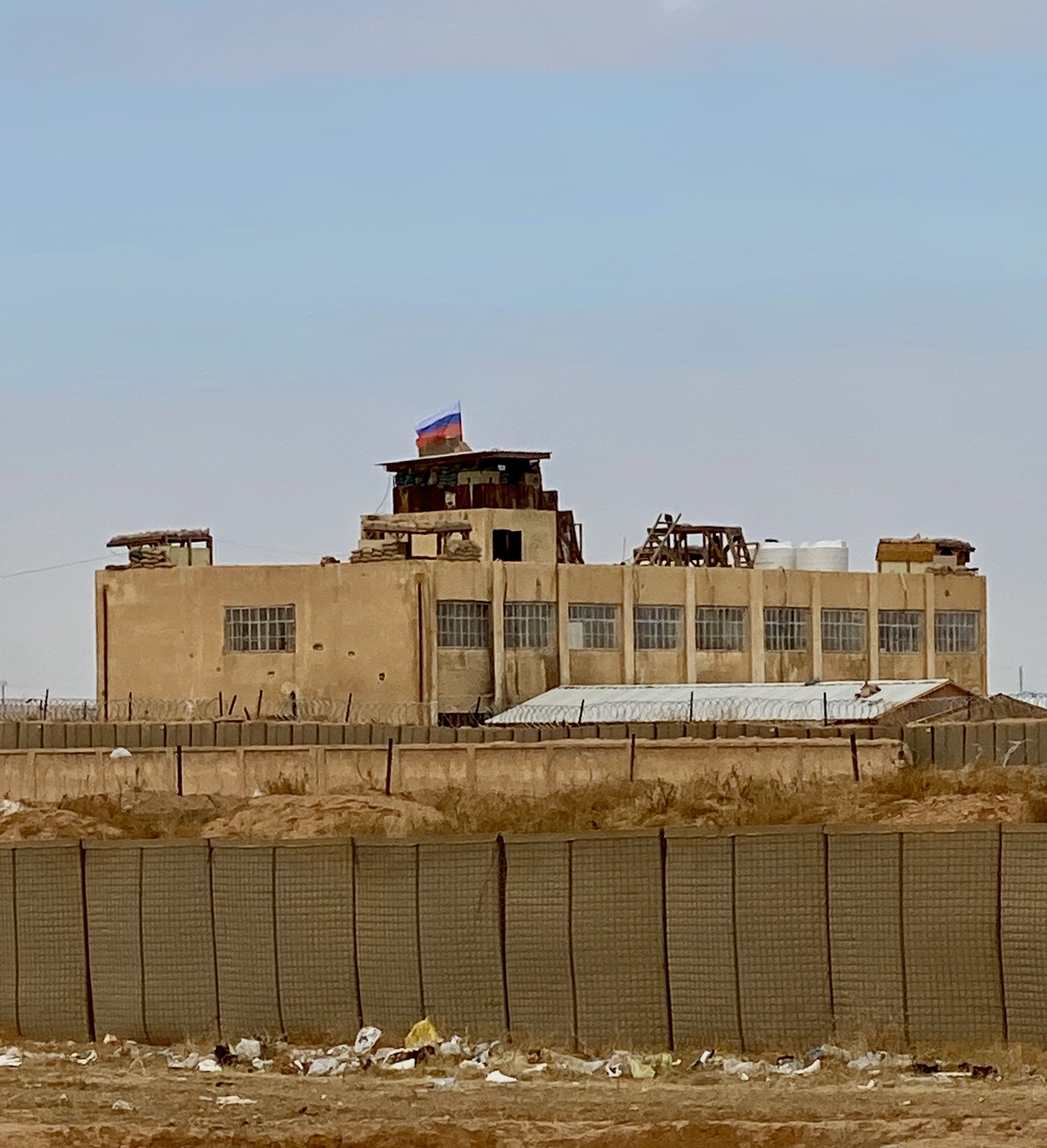
The US, seen convoying from Qamishli and heading west, is fully moving out (again?), and the Russians are fully moving in. They have their flag up at the main base. This explains why they were being so oddly protective of that area the other day. Russia is its own side.

Ayn Issa:

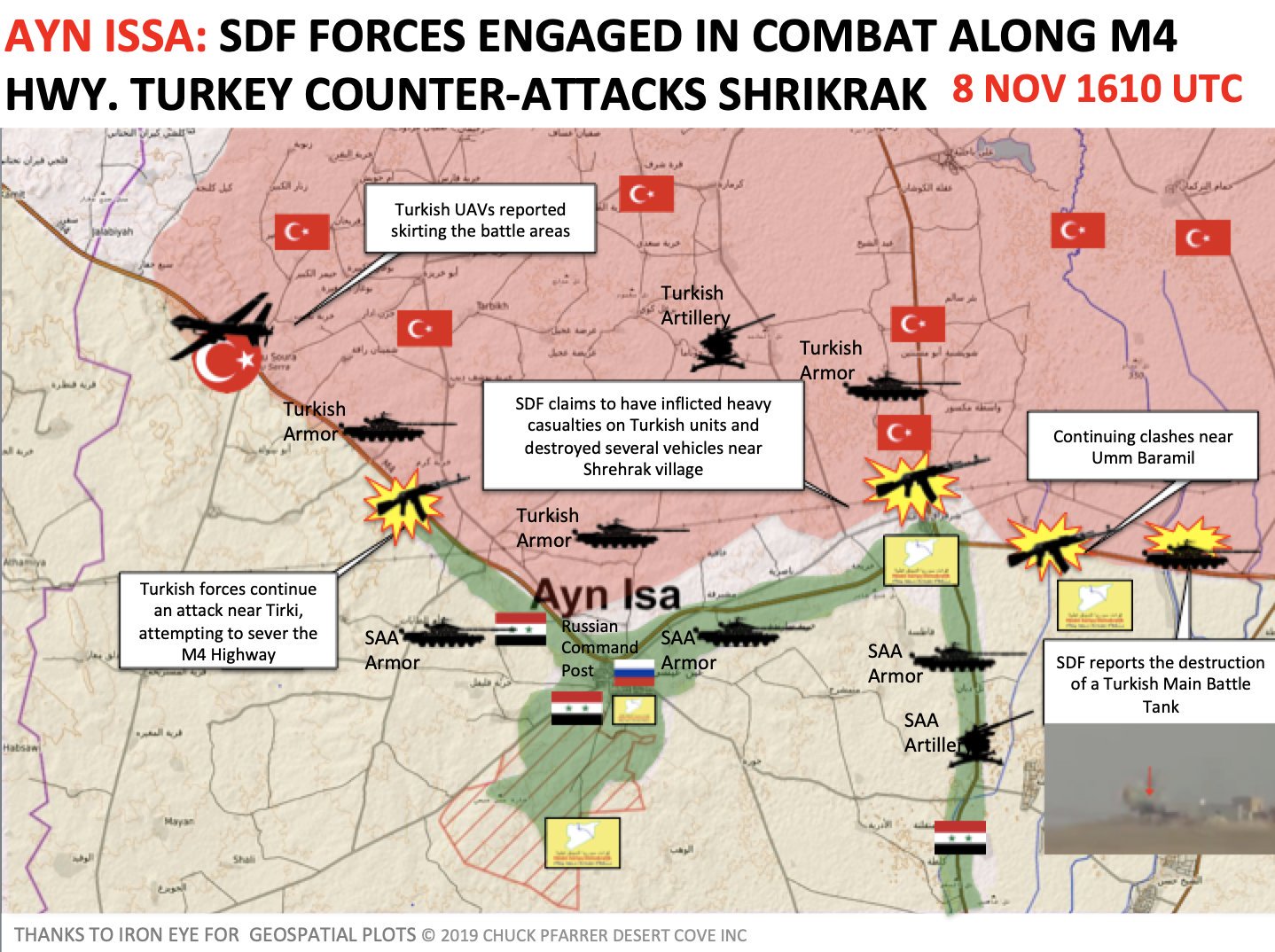
Fighting. Drones. A lot of the same. Four Arab tribes have joined SDF in the region .

This is like a day old but it’s basically the same.

ROJINFO: Syria: Turkish drones bombard a town near Ayn Issa

WARNING GRAPHIC VIDEO

Ras al-Ayn/Tal Tamer:

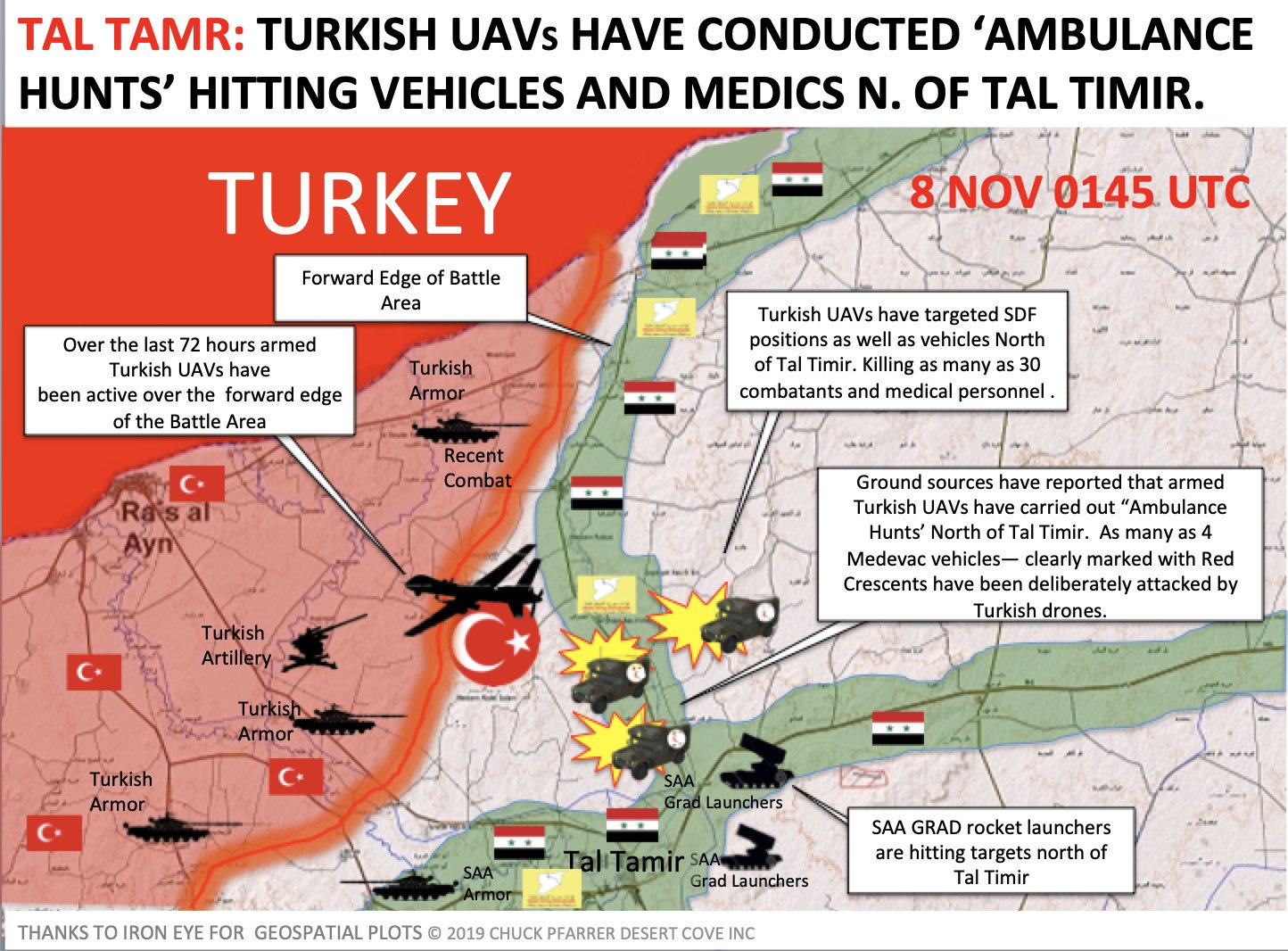
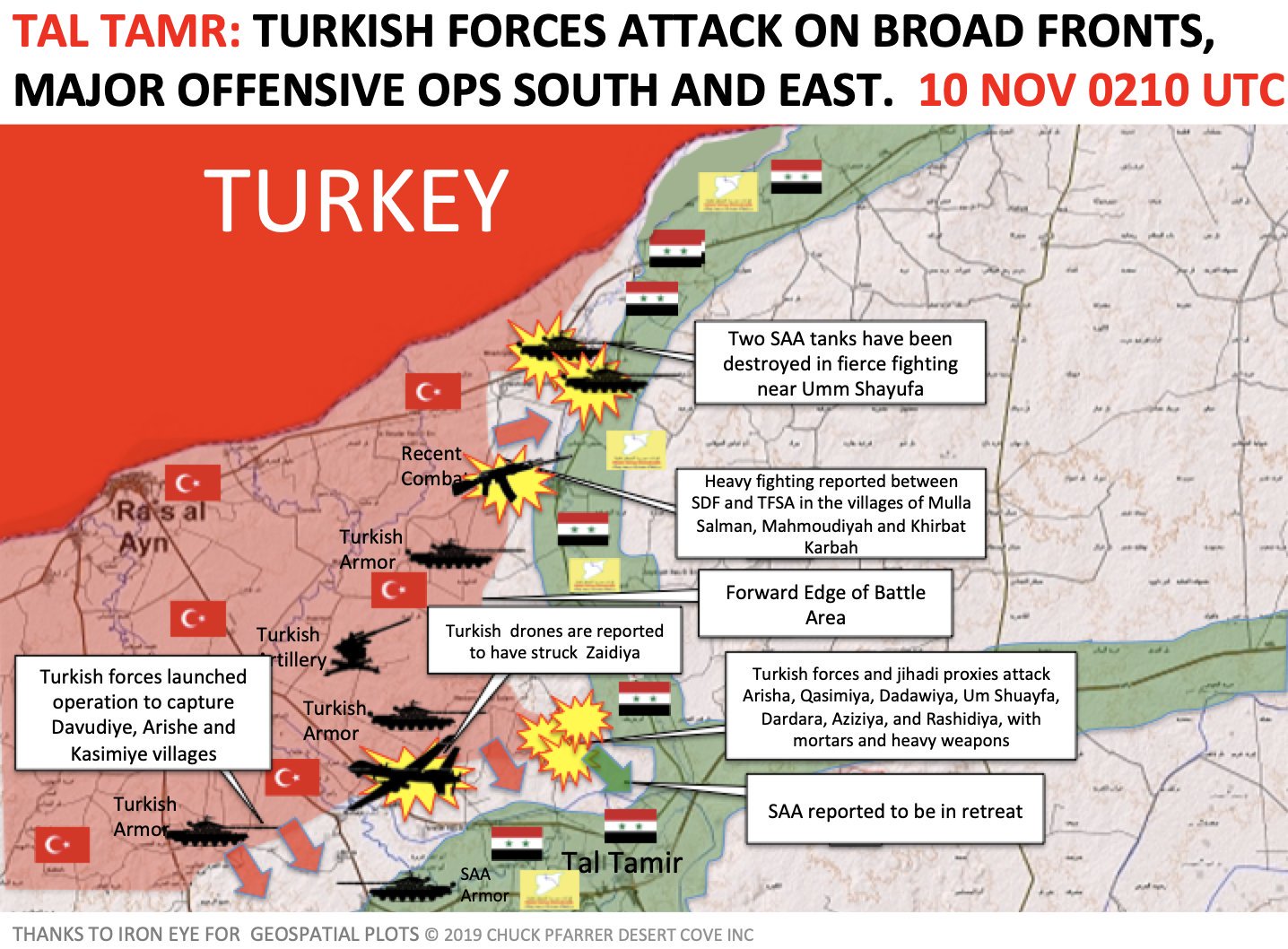
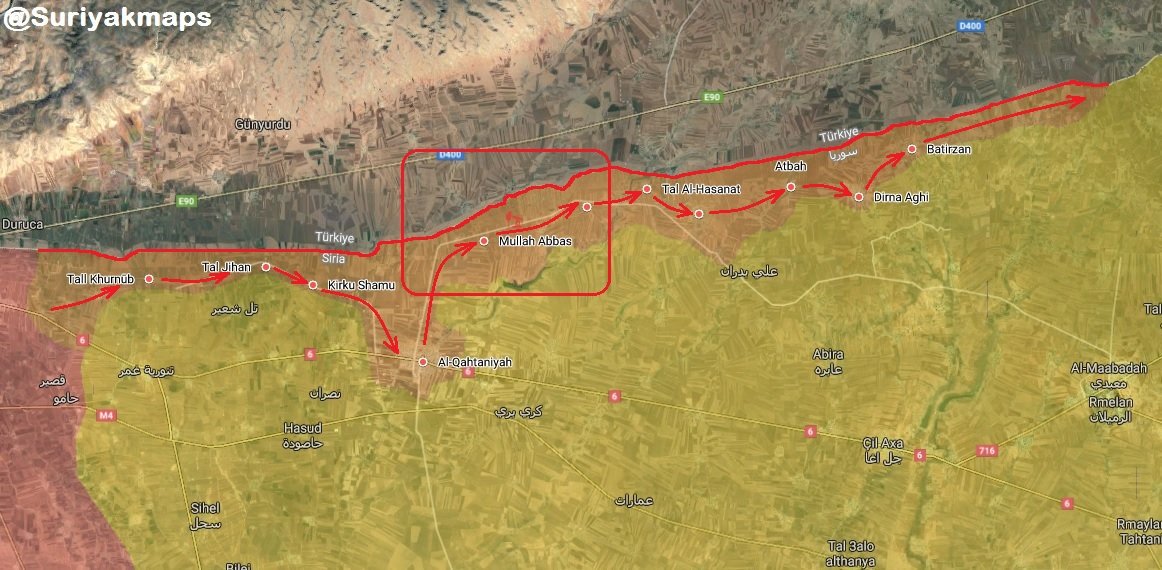
Heavy fighting with shelling and air strikes, including ambulances. It was chaotic enough that there were conflicting reports, but ultimately it seems SDF were south of SAA who beat back the Turkish forces and hen both pushed towards Ras al-Ayn from northeast of Tal Tamer.

ISWNews Analysis Group: From last night so far the engagements have intensified in northern axis of Tal Tamar.

SOHR: With the intensive support from the Turkish artillery, Ankara-loyal factions carry out new attacks in areas between Tal Tamr and Abu Rasin (Zarkan)

SOHR: Turkish drones continue the intense targeting of several locations in the area between Tal Tamr and Abu Rasin and cause more casualties, as the violent clashes continue in the area

Qamishli:

Assad’s SAA has established more of a presence, to the US, Russia, SDF, and Syria and probably some Iranian spies are all there. This is likely why the locals keep throwing rocks.

Uh oh… So much for my Qamishli update. Gooooooood more-ning Qa-mish-liiiiiiiiii!!

Qamishli: Revised

Car bomb exploded. US troops being pelted by rocks.

Darnell’s Son

Me too, Chewie. Me too.

But they’re not out of rocks.

This one is amazing:

Darnell’s Son

The rock throwing is just… I dunno… I love it. I wanna throw some rocks.

Reverend

I find the rock throwing captivating as well. If that hasn’t come across.


Nov 9 (8/8): NATO v. “The Ottoman Slap”

I’m still waiting for the Roebuck memo discussion to blow up.

le sigh.

In the mean time: What are we doing here?

Stars & Stripes: For east Syria, US troops are about much more than oil

Stars and Stripes: For east Syria, US troops are about much more than oil

The military understands the mission is not oil and not Rojava for that matter, but Iran.

“The revenue from this is not going to the U.S.,” Hoffman said.

From the ground, the new U.S. mission blocks Damascus’ plans to regain the east and Iran’s efforts to complete a land corridor through Iraq, Syria and Lebanon. Iran’s ability to project power and potentially transport advanced weaponry all the way to Israel’s doorstep has long been a major U.S. concern.

“Iran is the real danger,” said Omar Abu Layla, a native of Deir el-Zour who lives in Europe and runs an activist collective called Deir Ezzor 24 that monitors developments in the area.

This is about attempting to pivot while ostensibly not changing anything.

Hassan Hassan, a Syria and terrorism expert with Washington-based think tank Global Policy, said the new mission is “a recalibration of the previous plan, currently focused on Iran and the (Syrian) regime.”

It is not, however, “part of a thought-out and politically sustainable strategy,” he said. “The risk is that Trump will order a sudden withdrawal when something goes south.”

Assad has been making veiled threats.

In a subtle hint, Assad said in an interview last week his military is no match for the U.S. forces but their presence may spark “popular resistance,” likening it to what happened in Iraq before the U.S. withdrawal in 2011.

The civilians on the ground understand all this.

Residents of the east are already wary of the forces of Assad and his Iranian-backed allies, deployed just across the Euphrates.

Reports have circulated among locals that government troops were massing and Iranian-backed militias arriving from Iraq. Kurdish-led forces and government troops clashed Tuesday near the town of Husseiniya, according to Deir Ezzor 24 and the Syrian Observatory for Human Rights, a war monitor group.

The Observatory said the clashes prompted the U.S. military to fire rockets at the government forces. The U.S.-led coalition denied firing, but the reports underscored the possibility of frictions.

The fears sent prices of basic goods shooting up as people began to horde. Many considered fleeing, said Shehab, who had to leave his home west of the Euphrates when government forces moved in two years ago. Iranian-backed militias are recruiting and confiscating homes across the river, he said.

Here’s some good context for that mission vis-a-vis our relationship to Turkey:

National Review: Turkey, NATO, and a Shifting World

National Review: Turkey, NATO, and a Shifting World

Turkey is a strange ally of the United States, and a strange member of NATO. This has been clear for several years now. It has become yet clearer in recent weeks.

. . .

It perhaps goes without saying that it is very, very unusual for one NATO member to threaten another with the total destruction, or obliteration, of its economy.

The US and Turkey have basically been talking shit to each other. Erdogan referenced “the Ottoman Slap.”

On October 11, U.S. troops who had not yet cleared out of the region came under artillery fire from the Turks. (No one was harmed, or at least no American.) U.S. officers said that this was no accident: The Turks knew exactly what they were doing. And why were they doing it? To announce that there was a new sheriff in town? To administer something like “an Ottoman slap”?

This phrase had been introduced by Erdogan in early 2018. He used it in a speech to his parliament, responding to an American general, Paul Funk. Funk had warned Turkey not to tangle with Americans in Syria. “You hit us,” he said, “we will respond aggressively. We will defend ourselves.” Speaking to the parliament, Erdogan said, “It’s obvious that those who say ‘You hit us, we will respond aggressively’ have never received an Ottoman slap.”

The USA and Russia both vetoed the UN Security Council Resolution against Turkey.

Despite this threat, several EU nations have responded to Operation Peace Spring, imposing arms embargoes on Turkey. These nations include Germany, France, Sweden, and Finland. Also, a group of EU nations on the U.N. Security Council proposed a resolution against Turkey. The resolution was vetoed by Russia and the United States — a surprising pairing. This produced headlines that you perhaps had to read twice, such as “EU Stands Alone against U.S. and Russia on Syria.”

Turkey was obviously admitted to NATO for strategic reasons of geography and to a lesser extent demographics. But it would never be admitted today.

If Portugal was of strategic importance, Turkey certainly was, and is: a literal bridge between Europe and Asia, bordering the Arab world, bordering Iran, bordering the Black Sea, the Aegean Sea, the Mediterranean . . . When considering the question of NATO and Turkey, says Eric Edelman, you have to remember an old adage. Edelman is a former U.S. ambassador to Turkey and a former Defense Department official. The adage is one that President Trump is no doubt familiar with, as Edelman says, for it comes from the world of real estate: “Location, location, location.”

Furthermore, Turkey is a majority-Muslim country, and this can be useful in international disputes. An action may be seen as less “anti-Muslim” if Turkey is involved. There are some 2,000 American troops in Turkey, and nuclear warheads as well — American nukes, about 50 of them, at Incirlik Air Base.

Turkey would never be admitted to NATO today. It has an authoritarian regime, with democracy an increasingly distant memory. NATO is not admitting such countries anymore; it has stricter democratic criteria. But Turkey is grandfathered in, if you will. Other NATO countries have “backslid” as well, in the course of these decades — Greece, for example, during the Regime of the Colonels (1967–74).

Erdogan is kinda pissed about all that. The piece lays out the arc of Turkey trying to join the EU when Assad’s regime began in 2003 to their more recent truculent bitterness about Europe, but the best NATO can do is hope Turkey asks itself, “What Would Peter Parker Do?”

Does NATO have any tools, any leverage? Something with which to chasten or reform erring members? There is always moral suasion — but this can seem weak and pathetic. As Turkish forces and their associated militias were doing their worst against the Syrian Kurds, the secretary general of NATO, Jens Stoltenberg, was reduced to saying, “Turkey is a great power in this great region, and with great power comes great responsibility.” This must have occasioned guffaws in Ankara. What NATO can do, however, is distance itself from Turkey. Freeze it out. Stop sharing intelligence, stop sharing technology. And this, NATO members are already doing. Erdogan is not complaining about it publicly, says Ben-Meir — but he knows he is being marginalized, and he will complain about it publicly before long, almost surely.

If you freeze out Turkey, you have to replace it with something. You have to replace what Turkey has brought to the alliance, which is considerable. Already, there is “open conversation” about this, as Nate Schenkkan says. He is an expert on Turkey and Central Asia at Freedom House. Where are you going to get another air base, so desirably positioned? Where are you going to store your nukes? What are you going to do for ports? How about reconnaissance and surveillance capabilities? Current discussion revolves around Greece, Cyprus, Romania, Jordan, Iraqi Kurdistan, and still other locales.

Conclusion, we might need to rethink this, up to and including how we think about political realism in international relations.

I myself think of the Palmerstonian adage: Nations do not have permanent allies but permanent interests. For some years now — at least half of Erdogan’s 16-year reign — Turkey has not looked like an ally, certainly not of the United States or NATO. Mark Esper, the U.S. secretary of defense, said on October 21, “We had no obligation, if you will, to defend the Kurds from a longstanding NATO ally.” Does this kind of thinking make sense in today’s world? Does it comport with the realities on the ground? Does it jibe with conscience? Remember, U.S. forces took off from Erbil, not Incirlik. And, according to various sources, among them U.S. officials, Abu Bakr al-Baghdadi was located thanks to Kurdish intelligence.

No one, including me, has an easy answer to the Turkish question, and the specific question of Turkey in NATO. Nate Schenkkan asks, “What does it look like to have an ally that’s not fully trusted within the alliance?” We are seeing that now, as he says. “It is uncomfortable, and challenging, but not unmanageable. And people are getting used to the idea.” True.

In related news:

Bosnia would like to know WTF France?

France dissed Bosnia in an east-west tension kind of way, an historical problem within NATO. (This of course on the heels of Marcon claiming NATO is brain dead, ostensibly because of its inability to rein in an “eastern type state.”)

Reuters: French ambassador in Bosnia summoned over Macron’s ‘time bomb’ remark

About that Wall…

Finally, I at last get why I’ve seen more stuff about the Berlin Wall in ME stuff than I would have expected. But that’s clearly because I’m an idiot, as the connection isn’t that obscure.

Arab News: How the fall of the Berlin Wall influenced the Arab world
Nov 9 (7/8): Mr. NATO Goes to Washington

The White House announced that Trump would meet with NATO Secretary General Jens Stoltenberg next week.

They’re going to talk about your wireless 5G network.

“The President will also stress the importance of strengthening the NATO Alliance’s defense and deterrence against external threats, maintaining the focus on counterterrorism, raising Allies’ awareness on protecting 5G networks and critical infrastructure, and building resilience against cyber-attacks,” the White House added.

As Marciano490 said, just allies helping allies.

The Hill: Trump, NATO chief to meet at White House

And other stuff. I guess.

Here’s an interesting short piece on the context of the challenges facing NATO right now. Basically, once UK brexits, NATO becomes even more unbalanced, with respect to “North America,” which also, for NATO, emphasizes that relying on EU is insufficient because it lacks the connection to the USA.

ukdj: After Brexit ‘80% of NATO military might’ will come from outside EU

Turkey is forcing a reckoning in Europe and in NATO.

It’s what Turkey has always wanted. Good for them.

Nov 9 (6/8): The SNA, Tanf & Whatever the US is Doing

dhappy42

Who controls the white patch south of Palmyra along the border with Jordan and Iraq? Nobody?

I think they are Syrian rebels that aren’t really connected to any of the others, but I don’t look much because nothing’s been happening down there since I’ve been following along. What we call the SNA is just a collection of a ton of different militias who joined together in common cause. [Note: This was mostly if not completely incorrect; it applies to many SNA factions, but not the presence at Tanf about which the question focused. See below.)

What we call the SNA is just a collection of a ton of different militias who joined together in common cause. (For the Wikipedia list of TFSA militia, see the bottom of this post.) They are Syrian rebels that aren’t really connected to any of the others. I don’t know who, if anyone, the rebels in the south are affiliated with.

Because of distance and a lack of power, they have limited use to the common cause of the factions to the north and northwest, so they’re just kinda.

Except that we have some unheralded forces parked there too, I’m going to guess to protect the border crossings to Jordan.

I think Assad is mostly just ignoring them until later.

Narrator: It’s later.

dhappy42

Back in the Iraq war days (and probably long before that) the area where Syria, Jordan and Iraq borders met was smuggler central. Tanf is on the only road between Damascus and Baghdad and therefore the only open overland route between Syria and Iran. (The other road goes through Kurdish territory in Iraq.) The US used to have a base near there.

Reverend

Seriously, though, I hadn’t figured out why there were American forces there. You’ve made things a lot clearer in that regard, now. We don’t have troops at both of the eastern routes; we have troops at all three.

I get it now.

So now, a note on factions:

Wikipedia list of just TFSA militias

National Army

Hawar Kilis Operations Room

Military councils

  • Al-Bab Military Council
  • Mare’ Military Council[24]
  • Qabasin Military Council
  • Akhtarin Military Council
  • Menagh Military Council[81]
  • Tell Rifaat Military Council[82]
  • Deir ez-Zor Unified Military Council[83]
  • Raqqa Military Council[84]

Other Turkish-backed rebel groups in the area

That’s too many.

Nov 9 (5/8): SDF Explains Who ISIS Is. Or Tries.

SDF continues their messaging strategy of trying to let the facts and their behavior speak for themselves (they even “police” each others’ behavior on line if someone posts something phony. “We’re better than that!)

The SDF (and affiliates) haven’t been posting videos like this until very recently, whereas the SNA has been for some time, frequently with them acting viciously towards captives, etc.

This is basically submitted without comment:

I’ll comment: Who in the ever loving fuck uses landmines in a situation like this? I mean, do they plan on living there or not? Jerks.

Edit: This one has more to “say,” but it has the same intention.

Edit: Get the video while it’s hot because it looks like Twitter is deleting them.

Which is a response to getting this information out:

https://hawarnews.com/en/mobile/?page=haber&ID=12627

Nov 9 (4/8): Pulling Some Things Together

Received a good general summary of things to date, so I’m posting it here.

AlJazeera: Turkey’s Operation Peace Spring in northern Syria: One month on

The map of Turkey’s plan in effect in that piece is fantastic. Among other things, it shows Rojava keeping all their land as semi-autonomous… except for all the major cities which are under at least shared control with Assad? And Erdogan controls the M4, with a couple de facto check points for Assad?

Slick.

Taking away the social and economic centers of a people such that their identity becomes decoupled from place is like Ethnic Cleansing 101. To say nothing of the loss of economic and political power.

Good summary too. Great find.

Edit: Wait, Turkey is going to fit how many refugees into the territory in Syria they occupy? Tal Abiad, for example, has a current population of like 15k.


US Keeps Trucking.

So, in the middle of the night, US convey including 20 unladen trucks heads west into the heart of Syria on the M4 from Qamishli to the east to… go somewhere and do something.

This is widely believed to be the convoy to withdraw the last of American troops from the Kobani area—Hoffman mentioned such in the Pentagon briefing.

To Whom Are We Reacting at This Point, Anyway?

Possibly in connection to a new phone call between Putin and Erdogan?

26707

Barzani Has a Way with Children. Sorta.

Meanwhile PM of Iraqi Kurdistan Barzani, egos been kinda tone deaf about a lot of this visits a refugee camp in northern Iraq’s and speaks some of the scariest words imaginable:

Why would you tell a child that about a refugee camp???

I hope I’m missing something or there’s a translation issue somehow. That’s it. Not like everything in this conflict doesn’t go sidewise, so hey, why not comforting kids, too? We can screw that up well enough.

That was awful. I need to make up for that little bit of color. My apologies.

This should do it, I hope.

DHAPPY

Unleash the puppies of war!


Nov 9 (3/8): Ground Game

Ground Game:

Turkish forces have been creeping the water station near Sari Kani/Ras al-Ayn in Hosakah province, which  they have shelled before causing a humanitarian disaster. This is northeast of Tal Tamr where there has been very heavy fighting with both SAA and SDF fighting Turkish forces and SAA driving TFSA back towards Sari Kani. It sounds like it was a bloodbath, but then SAA started really letting the TFSA have it. And obviously a lot of this is outside the safe zone. The safe zone remains basically bullshit; it holds in some places, but that’s just because Turkey would get its ass kicked if it directly attacked Russia in the west or the US in the east (and Russia too, for that matter, but less so), so the places where the safe zone is not violated is not because Turkey is choosing to abide by it, but because it can’t.

It’s another day in Idlib, with more reports of Russia hitting what should be non-military targets, like an IDP camp. People attribute it to malice, but I’m not sure if it’s not that they just don’t give a shit. I don’t know.

Qamishli: The daily rock patrol seems to be getting more intense as the people become more emboldened. Lots more climbing in the trucks and driving them off the road. The Russians must love it after the couple weeks they had of flaunting the fact that nobody would shoot at them. Though I guess still nobody is shooting at them, exactly.

Macro Issues on the Ground:

The M4 is still blocked, requiring the use of secondary roads. This has caused food prices to spike.

Russia is not controlling the airspace over northern Syria—or rather, they are not restricting it; Turkey makes extensive use of drones in both the Ain Issa and Tall Tamr regions. They do seem to be protecting the Manbij and Kobani region both with armor and helicopters. Not sure why, but that area keeps being treated differently.

Strategy?

For obvious reasons, there is a fair amount of suspicion on the ground about Russia’s role, especially since they are hammering SNA in the west, so pretty much everyone in all sides is giving Russia the side eye but nobody can do anything about it. They’re now compared by SDF types on the ground as similar to the US in that Russia is around but not actually defending them.

What makes it so different from the US is that Russia appears to be completely in control, and yet they’re still acting in ways nobody can figure out. People there seem to understand that US’s divided government means policy can get weird with advocates and detractors in the same administration. Putin’s Russia has no such division, so what happens is something that he is doing on purpose and that’s not gonna change (so whatever this is, it’s what he’s about), whereas America might be induced to help.

So, with many anyway, Russia is currently about as popular as one might expect.

Nov 9 (2/8): US Envoy to Turkey: Why?

US envoy to Syria James Jeffries is in Turkey for meetings with “senior Turkish officials and members of the Syrian opposition,” which means SNA but not SDF.

Anyway, here’s what there is to know about the visit:

Why the US says he’s there:

Special Representative for Syria Engagement and Special Envoy for the Global Coalition to Defeat ISIS Ambassador James Jeffrey will travel to Ankara and Istanbul, Turkey, for meetings with senior Turkish officials and members of the Syrian opposition on November 8-9, 2019.  Ambassador Jeffrey is leading an interagency delegation to discuss issues of mutual concern to include, the current situation in northeast Syria, implementation of UNSCR 2254 on the resolution of the Syrian conflict, and our continued efforts to ensure an enduring defeat of ISIS.

Why Turkey says he’s there:

That the video clip is a Tweet response to the stuff about joint Russia-Turkey patrols it pretty slick. The way information is bundled to try to influence the connections people draw is fascinating.

Synopsis: Three Purposes for the Meeting

  1. Ensure the implementation of the Oct 17 agreement for temporary cease fire for YPG to leave the safe zone.
  2. Discuss Erdogan’s trip to Washingnton, DC on Nov 13. This trip is really paving the way and is a scene setter for the upcoming meeting where they will discuss among other things  trade, anti-terrorism, and of course, Syria.
  3. The fight against Daesh, which is important to Turkey and the US and to everybody in the world so we should work together.

Why is he actually there?:

The Guardian: ‘Secure the oil’: Trump’s Syria strategy leaves Pentagon perplexed

This is a really good summary of the weirdness of the conflicting expressions of US policy in Syria and how different people are trying to navigate it. It also does a good job distilling what came out of the Pentagon press conference the other day that “re-articulated” and reaffirmed the US mission in Syria.

Geekier elaboration of problems:

ForeignPolicy: The Realists Are Wrong About Syria

Turkish POV of Situation

The points of emphasis for Turkey, particularity in terms of their breadth and emphasis on US and Turkey as both economic partners in addition to being valuable partners in the GWOT is, I think, instructive. Almost like the war in Syria is really just a good hook to get the United States to take a meeting; it just happens to be one of many things to discuss.

Why Is Enes Kanter So Awesome?

Controversial stuff. Food is very political these days, for example, to say nothing of the Les Miserables Problem.

Let’s see if the comments become a bloodbath.