Dec 02: NATO, Turkey & US: A Viewer’s Guide

NATO is having a summit.

Among other things, the situation in Syria will be addressed.

Specifically, NATO wishes to address this fact:

Turkey is holding up a defense agreement for the protection of the Baltics from Russian aggression unless NATO pledges to label the YPG of the Syrian Democratic Forces a terrorist group and assist Turkey in their destruction.

This is very difficult to follow in the American news media as the situation in Syria tends to be divorced in coverage from the political context.

The result of this disconnect is that it appears that little can be done when, in fact, as we shall see below, it’s really a matter of political will.

But first: Erdogan’s opening salvo right before the talks to set the scene.

We will get to that later, at the end of the piece. The images are difficult to view and I want to give readers the option of reading this post and not seeing them if they so choose.

I think the images are important, but I understand they are deeply disturbing.

So first, we’ll go over how Rojava and the conflict in Syria fit into the NATO meetings and the politics. And then we will return to the news of the mortar shelling of the school.

Back to NATO

The Masters of the Universe are having a summit beginning tomorrow in London.

Among the biggest issues to be addressed is Turkey’s refusal to sign onto Baltic defense against Russian aggression unless NATO agrees to classify the YPG as a terrorist organization and agree to help fight them.

Al-Monitor: Acrimony erupts ahead of NATO summit as Turkey stalls defense plans

erdogan nato pic 12-02-19

Turkey wants NATO to support its fight against the Syrian Kurdish People’s Protection Units (YPG), including designating the group a terrorist organization, before it signs off on plans to defend the alliance’s eastern flank against Russia. Turkey entered northeast Syria in October, forcing Trump to hastily evacuate troops who were battling the Islamic State (IS) alongside the Kurdish militia, without consulting European partners; this effectively turned over territory to Russia and the Syrian government.

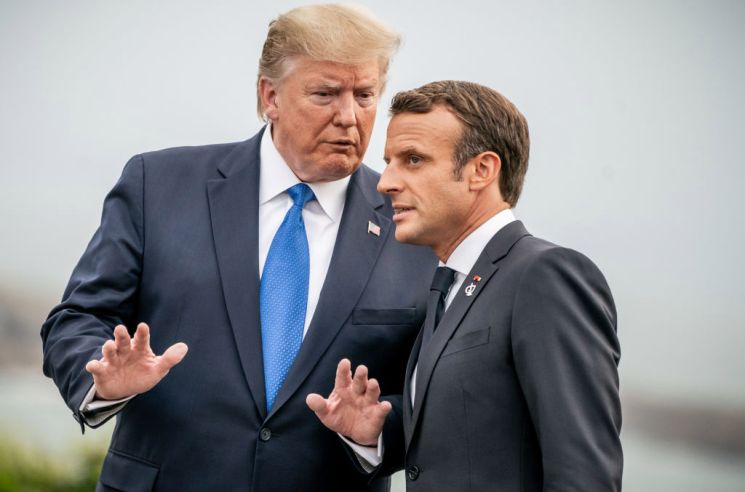
Turkey can’t expect solidarity from NATO if it presents a “fait accompli of a military intervention which endangers operations against IS by the coalition, of which NATO is a member,” Macron said Thursday. Turkey has drawn the ire of other European countries for the invasion.

The acrimony reached full throttle Friday when Erdogan called Macron “very inexperienced” and told him to “check your own brain death first.” France in turn summoned the Turkish ambassador over the insults.

American sources are barely even covering Syria at NATO, even though Turkey’s demands with respect to Syria, like, hold up all of NATO. They literally call NATO itself into questions.

Seems relevant, one would think.

Everyone in the world, especially people on the ground in Syria, knows that’s what this meeting is about—what it has to be about. NATO.

Like, beyond Syria, it’s about the integrity—and not just moral—of NATO. Turkey’s pressure is an existential level crisis for the organization, as Macron of France has been trying to tell anyone who will listen. Which is nobody.

Instead, it’s presented here as mostly ego battles between leaders, what with Turkey buying the S-400 air defense system from Russia, which is a thing that happened, yes, but as a way of framing the summit it is basically wrong on its face.

I mean, even bracketing the awfulness in Syria—to hell with the Baltics, amirite?

What do they have to do with NATO and defense against Russia anyway, right?

NATO Summit in the News

Time: What to Know About the 2019 NATO Summit
G7 Summit in France

The biggest issue on the agenda is what Macron was referring to in his “brain death” comments. Macron’s intervention was a thinly-veiled criticism of President Trump, the commander in chief of the U.S. military — the force that has largely underpinned NATO’s might since 1949. Trump has said the U.S. is footing too much of NATO’s military bill, and has suggested he could pull out of the alliance unless other members begin to spend 2% of their GDP on defense.

In October, Trump withdrew U.S. troops from northeast Syria, clearing the way for a Turkish incursion against Syrian Kurds in the region — longstanding allies of the U.S. in the fight against ISIS, but seen by Turkey as enemies. Trump’s move angered Macron because he refused to notify NATO members of his decision before acting on it.

The French leader has made his frustration clear at Trump’s unilateralism, and will be seeking to convince the U.S. President to think about foreign policy in terms of Western interests instead of through his America-first lens.

“You have no coordination whatsoever of strategic decision-making between the United States and its NATO allies. None,” Macron told the Economist ahead of the summit. “You have an uncoordinated aggressive action by another NATO ally, Turkey, in an area where our interests are at stake.”

So according to Time, the issue with Syria is that Trump didn’t warn Macron about pulling US troops out. Plus they’re gonna talk about China and space.

Space is cool, I guess. I like space.

Rojava is responding with pictures of their dead kids. Frequently with apologies for doing so, but sharing them nonetheless, as hard as that must be. (See below.)

Turkey appears unfazed by these messaging tactics insofar as they appear willing, by recent and current shelling, to provide more such pictures for the world.

Like, basically right now.

The View from America

Despite the atrocities being committed in Rojava and Syria by a NATO member, American media continue to portray the problem as one of Turkey refusing to cooperate on Baltic defense over some silly sticking point or another.

Reuters: Exclusive: U.S. defense chief calls on Turkey to stop holding up NATO readiness plan

LONDON (Reuters) – U.S. Defense Secretary Mark Esper urged Turkey on Monday to stop holding up support for a NATO defense plan for the Baltics and Poland, as Ankara presses the alliance to support its fight against U.S.-backed Kurdish YPG militia in Syria.

In an interview with Reuters ahead of the NATO summit, Esper warned Ankara that “not everybody sees the threats that they see” and added he would not support labeling the YPG as terrorists to break the impasse.

Of course, Turkey doesn’t care about the Baltics—though Russia surely does—but rather is basically staging a grand performance demonstrating Erdogan’s ability to paralyze NATO and hold it hostage.

Turkey is effectively stating that it expects not only non-intervention on the part of The West, but expects its active support.

NATO, of course, has no constitutional way of expelling a member and constitutional amendments require unanimous approval.

Because apparently they don’t remember what WWII was, somehow. But that’s how NATO was started. It’s a mess.

Turkish Independence of NATO

Now, it’s not clear that Turkey had the school shelled on purpose to make a statement, or if it’s just more of the ongoing fighting that is ultimately meant to drive the people from their homes.

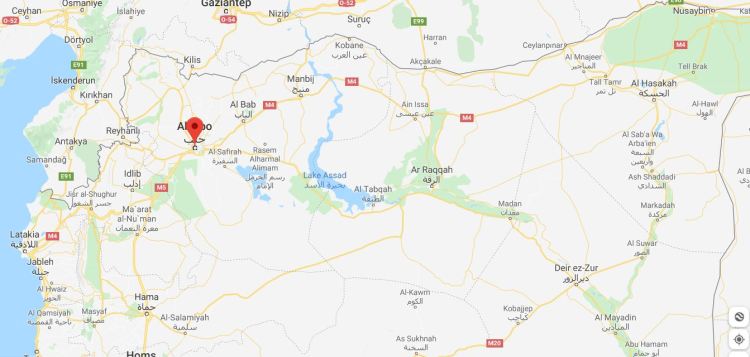
But it should be noted that, though not by Turkey, this has happened before in a similar way in roughly the same place, and it received international attention.

That is to say, it’s a meaningful place to do something like this.

New York Times: Children’s Art at Syria School, and Then a Bomb

aleppo school bombing old

Organizers had worked until dawn hanging children’s artwork on the wall of an elementary school in Syria’s largest city: a bright green tank under a round yellow sun, a girl in pigtails defying a soldier’s bullets, a missile plunging from a warplane toward the school building.

But hours before the exhibit was to open on Wednesday, creating a rare space for children’s creativity in a ravaged district of the northern city of Aleppo, Syrian government aircraft bombarded the school, residents and anti-government activists said. At least 20 people, including 17 students and two teachers, were killed, they said, and many were wounded, including the school principal and the local artist who mounted the exhibit.

Whether or not that was a strategic power chess move to hit the school in Aleppo the day before the NATIO summit, it is undoubtedly symbolic for the people on the ground, as this is the site of some of the greatest atrocities and humanitarian disasters of the war on ISIS.

The war on ISIS, which continues to this day, is of course the reason for the international coalition’s Operation Inherent Resolve in the first place, and remains the reason for the US military’s continued presence.

Finally, the politics of NATO trying to get Turkey to agree to Baltic defense while Turkey demands support in designating YPG of the SDF, the US military’s stated partners in fighting ISIS, as a terrorist organization, is really just the context for the larger unspoken issue:

Turkey’s will to operate independently of the norms of NATO.

We set up NATO for a reason, y’know.

Apparently intelligence analysts think the whole S-400 business with Russia is really actually about being able to protect Erdogan from a potential coup launched with the support of Turkey’s own air force’s US built jet fighters.

This is bad.

What’s worse?

It’s actually turns out to be pretty obvious.

Center for Strategic & International Studies (wiki):  Coup-proofing? Making Sense of Turkey’s S-400 Decision

Stated U.S. concerns about the deal have primarily centered on the threat to the advanced F-35 tactical aircraft Turkey was slated to acquire. Most of the time, the F-35 flies with an exaggerated radar signature so that anyone observing it will not see its true signature. Turkish operation of the two systems together—and more specifically, when it is in stealth mode—would allow the S-400 to acquire intimate knowledge of the F-35’s radar signature. Such insights would almost immediately find its way back to Russia, and the capability of F-35s around the world could thereby be degraded. The location of the Russian sensors on the territory of a North Atlantic Treaty Organization (NATO) ally also provides a more forward-based position from which to observe other NATO aircraft and military exercises.

Analysts have struggled to explain Turkey’s air defense actions. Western officials and analysts alike have gone, as it were, through four of the five stages of grief: denial that Turkey would go through with a seemingly inexplicable decision, anger at the repercussions for the NATO alliance and threats to withdraw F-35 participation, bargaining with renewed offers for the Patriot, and now depression over the forthcoming deployment.

Getting to the acceptance stage requires an appreciation of Turkey’s foreign and domestic political calculations, above all Erdogan’s desire for survival. Analysts have been scratching their heads as to the U.S. failure to dissuade Erdogan, but Occam’s razor may be helpful here. Erdogan may want the S-400 for the exact reason the United States does not want Turkey to have it: precisely because it is built to shoot down the American-made aircraft currently operated by the Turkish Air Force. Both political and military aspects of the S-400 decision make sense inasmuch as Erdogan’s top priority is his own political survival.

So Turkey buying the S-400 from Russia is really about the bad guys in the world trying to get the goods on the fifth-generation stealth F-35 Lightning II air superiority aircraft (wiki).

That’s bad. I mean, it’s Mission Impossible plot line bad.

Let’s also remember that Turkey could have just had the F-35. They were kicked out of the program for buying the S-400 from Russia.

So Turkey chose the ability potentially to shoot down the F-35 over the F-35 itself.

And yet, it’s worse.

A Capability to Shoot Down Its Own Planes

During the Turkish military’s attempted coup in July 2016, Turkish F-16 pilots bombed the Turkish Parliament and threatened Erdogan’s own plane. In the months that followed, Erdogan tried to “coup-proof” the country through mass arrests and by reportedly purging some 2,600 military officers, including half of Turkey’s fighter pilots.

Acquiring the S-400 may, in short, be part of Erdogan’s hedge against another coup, both by deepening his strategic relationship with Russia and by acquiring specific air defenses meant to combat another attempt to overthrow him.

Acquisition of the Patriot system would not fit in with Erdogan’s developing partnership with Russia. Nor would it suffice as coup insurance, since it is not tailored to shoot down Western aircraft. Having accused the United States of being behind the 2016 coup, Erdogan may be distrustful of U.S. air defenses to protect him in the future. Whether he is better off staking his survival on the Russians remains to be seen.

So Turkey wants two things out of this NATO summit:

  • The ability to insulate itself from any threat from NATO powers.
  • The acquiescence and even support of NATO in Turkey’s efforts to assert itself over the region with an eye to a return to the greatness of the Ottoman Empire with Erdogan at its head.

This ultimately all rests on Turkey’s—and Russia’s—ability to maneuver Turkey in such a way that NATO’s treaty obligations work against NATO’s norms and mission.

So at the end of the day, this really is a battle of political will—as true a battle of wills as we are wont to see these days.

Which is why it’s vitally important that people understand what is going on, and how the politics of the thing fit into the larger context of what Turkey is trying to do and how.

Which gets us back to Rojava. First, a plea from the ground.

Following this will be disturbing images; as per above, I think it’s important, but also, I feel obligated to offer fair warning. It’s bad.

An Open Appeal to NATO.

WARNING: GRAPHIC IMAGES

This really is the only way to understand what is going on on the ground, what is happening in the war, and what it means to the people there.
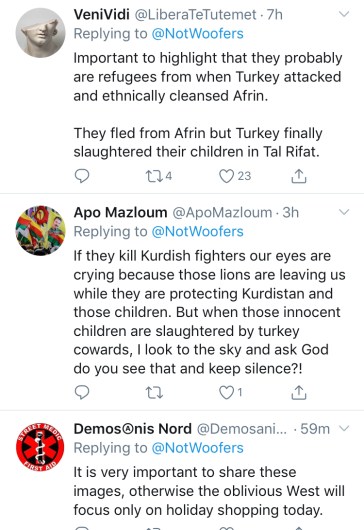
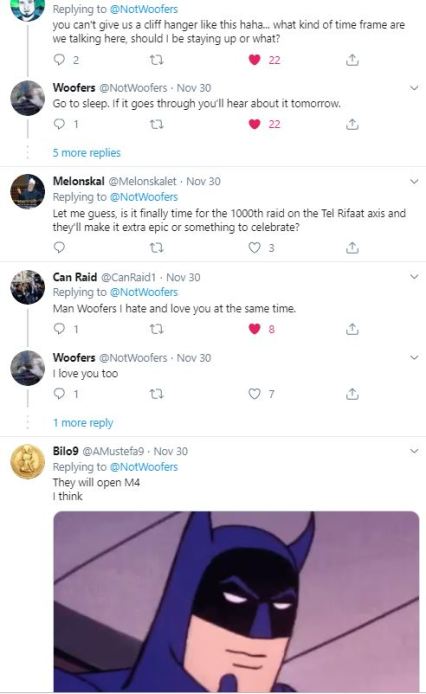
woofers dead kids replies 12-02-19.jpeg

Meanwhile, in Idlib:

One would think that the member states of NATO would just, like, set up a new NATO without Turkey. NATO.2 or something clever like that.

But to do so, all the countries would have to break the norms upon which such organizations are based. So there can be no faith in the institutions.

Or so it is alleged by those who would destroy them.
 

Dec 01 (2/2): Kurds, Culture & (^_^)/ Korea

So one of the unforeseen but in retrospect obvious—and pleasant—side effects of a project like this is learning about some of the “local” culture.

In this case, while many different cultural elements come up given the diversity within Syria, Kurdish culture comes up a lot for obvious reasons, most notably because Old Man Erdogan is trying to get it off his lawn, which he defines expansively.

So some of this—a lot of it, really—is going to veer in and out of Rojava proper, but I think it offers an interesting lens into Kurdish culture and, by extension, the peoples of Rojava.

Some of the first cultural elements I saw were in trying to figure out the fighting; that was my Twitter entry into Rojava.

As per their norm, the people on the ground who wanted The West to understand as much as possible about what was going on were very helpful.

So clearly, they have an awareness of being watched and heard by the world. Which is what I initially attributed all the dancing videos to.

One of the striking features of this conflict has been the pronounced difference between the images of ISIS guys trying to look hard and tough and mean and hard and whatever, and those of the SDF who not only aren’t wearing the same kind of mercenary chic but have different styles in even combat dress, sometimes armed while in customary dress in fact, and are seen playing with dogs and kittehs, singing and dancing and so forth.

I initially chalked all the dancing videos up to them trying to present an attractive public face.

And it certainly, is that. And they often strategic, because they need to be; survival of the people and all.

But over time, I realized it was more than that. Or maybe less.

It seems that they just really, really like dancing.

And, like, there is meaning to a people that really just wants to dance—

dazed and confused wanna dance.gif

—and the sentiment generally isn’t lost on people.

Now, that might seem superficial. But, like, take the point of view of this political anthropologist guy, Mike Aaronoff, who wrote this book years ago about the spy novels of John le Carre , the premise of which is:

If you only read sterile histories of the Cold War, you will never understand how crazy and intense it really was as experienced by the actual participants.

So to really get into a culture, read their stuff, listen to their music, try their food, and so forth. This isn’t breaking new ground, yeah?

I point this out because it’s not like America doesn’t have important myths that define us as well.

Some even involve dance.

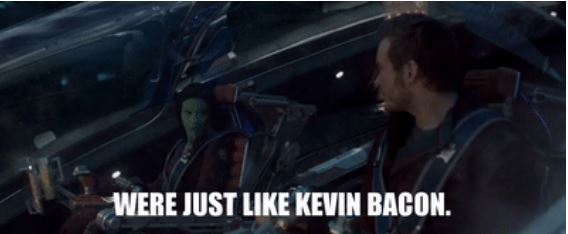
guardians of the galaxy just ike kevin bacon.gif

So the dancing is emblematic of the people’s culture legacy of enduring through all the combat, the war, the economic collapse—all the bullshit We know this story well.

deep impact life will go on.gif

And so it goes.

There were some great images out of the Iraq protests of protesters proposing in Tahrir Square and weddings right in the middle of the protests and stuff.

And Rojava it is no different. They’re getting married and Erdogan sure is shit ain’t stopping them.
So this is the local news, but you also see in their own news and interests (as viewed through Twitter, darkly) all sorts of stuff that is strikingly fucking normal.

I mean, I shouldn’t be surprised that Kurds do normal shit—hell, I found that Kurdish comedian before—but, like, when you’re introduction to a people and a place is combat, cities laid to waste, ISIS, Russians raising flags, US MRAPS rolling around apparently aimlessly, and town’s people throwing rocks, you can lose sight of some things.

Like that they play video games.

Or watch TV shows. [Looks like the Tweet of the guy asking for a link to The Mandalorian got deleted; dash cunning of him, the rogue.]

Or watch movies. Foreign films even.

So that’s just cool. That’s the guy from the helicopter again by the way, covering a bit of Kurdish appreciation of Korean culture.

I’m going to stick with “Korean” versus trying to delve into distinctions between South Korean and North Korean culture because that is way out beyond my depth. So I’m following the Kurdistan festival’s lead here.

Please forgive me if this… is somehow bad. ㅜㅜ

So yeah, cool: foreign film. Of course, I don’t know a lot about Korean culture, but I know it means at least two things.

First: taekwondo.

The other is obviously K-pop, but we’ll get to that in a moment.

First, I’m interested in this festival in general, yeah?

So this has been going on for a bit. Time to dive into those links, which eventually lead here:

RUDAW: Kurdistan holds first Korean Festival ‘Friends of Korea’

The Kurdistan Region held the 1st Korean Festival “Friends of Korea” on Saturday sponsored by the General Consulate of [South] Korea in Erbil and organized by The Center for Korean Studies in Kurdistan and the International University of Erbil. The event had a special guest speech by the Kurdistan Regional Government’s Head of Foreign Relations Falah Mustafa and attendance by the Consulate of the Republic of Korea in Erbil, Mr. Park, Young-Kyu.

Many cultural activities took place such as youth talent shows featuring K-Pop singing and dance performances, a Tae Kwon Do demonstration, Korean name writing, music performances of traditional Korean instruments along with showing of Korean costumes and face painting.
The event was held at the Public Library of Hawler-Zaytun at Sami Abdulrahman Park which includes the Zaytun Dispatch Memorial Hall, the name of the Korean Army unit present in Kurdistan to carry out peacekeeping and reconstruction-related tasks between 2004 and 2008 along with the Korean Culture and Information Center.

Aw-yeah. I’m not saying that K-Pop makes a festival like this authentic, but it’s probably safe to say that without K-Pop, it is not authentic. Not based on the people I’ve met anyway, although there may some selection bias there.

Now, you gotta understand the awesome that is K-Pop. It is like, the most rarefied form of pop music in the world today, in my opinion. It’s a lot like J-Pop, but then taken to the nth degree.

Now, J-Pop is pretty refined pop music in its own right, and certainly has its own aesthetic. But it’s wild, and po-mo as all heck.

As in, one of my favorite tunes sorta in the genre isn’t actually Japanese but initially recorded by a Swedish group. Only some musical mastermind figured out it sounded just like J-Pop if you nightcore edited the remix to speed it up to make a meme out of it.

Caramelldansen

I can’t find my favorite K-Pop video and it’s probably lost to the sands of time as there are a lot of K-Pop videos and asking Lord Google about “k-pop mega mashup 2010” doesn’t do a lot.

So I’ll use one of the favorite videos from a friend of mine who, as he says, shares my unabashed love for this… stuff. But he lives there and knows way more about it, so now I’ll follow his lead.

Now, if you watch that, you’ll understand the whole mash-up thing.

Like, this is a wild over-generalization, but a lot of Korean culture is about innovating and mixing and matching from other cultures.

This melding is the happy side effect of being a trading crossroads and the unhappy side effect of being invaded all the fucking time.

Sound familiar?

As per the last, Korean culture may be also at least in part be defined by its culture of resistance.

Seem familiar?

Why Resistance Is Foundational to Kurdish Literature

Now, don’t get me wrong: Nearly every culture has lore of resistance. Cultures and peoples that aren’t able to do the resistance thing tend to not to last very long, the world being such as it is, thus far anyway.

So it’s natural for such a tradition to exist in most if not all cultures, at least in some form. America has the Revolution and then the frontier. You’d think that would problematize the resistance narrative since the frontiersmen were resisting the people who lived there, but it’s really about scrapping to live.

And, anyway, that new frontier thing has a long history too. English history has people fighting fiercely for what really in many cases isn’t very good land, but it’s their land, dammit. And they became an empire, whether some of them wanted to or not.

Hell, ancient Rome has a founding myth of past greatness, but a ruined city in Troy, escaping and migrating (something of an odyssey, oddly enough), fundamentally enduring, and ultimately reaching the Italian peninsula where they aggressively resisted the tribes living there and there you have it:

Rome: Scrappy underdog.

Other countries might have arguably stronger claims to this tradition than Rome, but, bracketing some real serious grievances—especially those that require remedy—that sort of superior cultural justification debate is something I personally find to be of limited use.

Now, circling back, the Korean culture of resistance can be seen in their national martial art, taekwondo. So it wouldn’t be surprising to learn that the fighting style is associated with resistance, yeah?

But the martial arts—here I go generalizing again; please suffer my limitations here, as I swear there is a point to all this—the martial arts in Asia hold a special place in culture.

bloodsport martial science.gif

Specifically, while the arts certainly involve fighting, the art tends to have a lore of how it embodies the virtue of the people—that which they value and which makes a person—and by extension, a people—good.

Kung fu, for example isn’t a fighting style, but rather a way of life; wu shu is the name of the fighting style that is folded into the way of life.

Which makes sense that there would be one, as the good man (It’s gendered. Not my fault. We’ll see why this matters in a sec.), to do justice, must at times project force.

So fighting is a virtue. It’s about the judicious use of force that is inextricably linked to virtue.

This is fundamental to martial arts movies and what they embody. Check out this clip from The Forbidden Kingdom, which is essentially a primer on kung fu films put together by two legends of the genre: Jet Li and Jackie Chan.

https://www.youtube.com/watch?v=Vx-1lgnGULg

As the immortal says:

Kung fu, hard work over time to accomplish skill.

Now, my understanding is that “kung fu” literally in Chinese means, “virtuous man.” So the key insight here is something like this.

kung fu equals time plus work

Or, insofar as work can be done poorly and virtue depends upon doing good and doing it well, it makes more sense to think of it as a function of time and work.

kung fu equals function of work

In other words, to really have the virtue of a good man, you have to work at it for a long fucking time.

Now, most martial arts traditions have something like this, some lore that teaches the value of work and learning and what that gets you and how a strong people needs it.

But there is also some more fundamental sense of moral power. This is why so many movies in this tradition have examples where an older, purer form of the art defeats one corrupted by evil—as in The Karate Kid where the student learns a more ancient, traditional, familial, and hence more effective karate.

The idea here is that, for anyone who spends significant time on learning, if that person is still evil—uses their kung fu to pursue selfish ends—then this is a person who has learned nothing through the struggle and ought justly to be reviled.

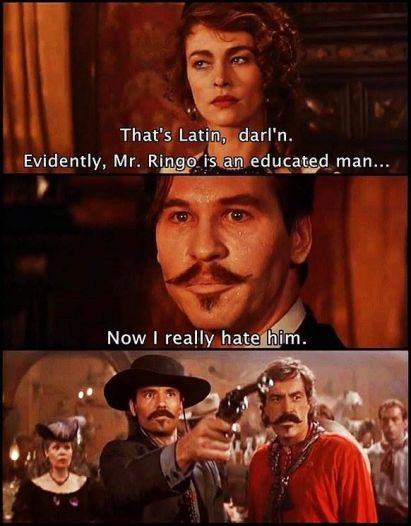
tombston latin educated man hate him

Shooting people is no less a martial science than punching someone in the face; indeed, the pistol’s nickname in American westerns, at once “equalizer” and “peacemaker,” symbolizes a nation navigating the tensions of liberal (small L) democracy.

And it’s no accident that The Magnificent Seven is based on The Seven Samurai, which is in turn based on the much more ancient Seven Against Thebes.

So in the traditions with which I am most familiar, we’ve been writing these versions of this story for at least 2,500 years.

We’ve been telling them to each other for even longer—even before the advent of writing.

Now, obviously any culture values good things—has things they consider good—but may not value them equally, or there may be different priorities in the hierarchy of the elements of justice for that culture. And those values—and virtues—permeate the culture.

I mean, that’s arguably what culture is.

So it will also permeate the art. Or, rather, arts.

So, without elaborating on the legends too much (where I would undoubtedly get myself in trouble), Chinese gong fu has things like the Buddha visiting the Shaolin temple to teach the pious but unhealthy monks (all they did was pray and meditate all day) this physical art which also allowed them to project their moral strength. And there’s the Boxer Rebellion where kung fu became emblematic of the power of a people to rise up and assert itself as a collective body—not coincidentally a narrative of resistance.

Similarly, Japanese martial arts have traditions such as that in Okinawan karate of regular farmer type plain folk learning to defend themselves, but also Bushido and the Samurai code of honor emphasizing discipline, responsibility, and loyalty.

I think that’s right, anyway. If not, it’s something like that. I hope.

I would be remiss if I didn’t here note that Japanese swordsmanship has it’s own version of the American western quick draw; it’s called iaido.

The disciplines and their associated life curricula are similar, and different, and each constitutes an attempt to orient people towards the good.

And so each tradition of course has their own literature. China has Sun Tzu’s Art of War. Japan has Miyomoto Musashi’s Book of Five Rings.

A taekwondo book is likely to be a manual of how to kick someone in the throat.

And it would probably then include a discussion of why that takes too long and leaves your defense open to riposte, so a back-kick, often considered taekwondo’s unique and powerful contribution to martial arts, is a better choice.

So, while not doing justice to the cultures involved (I decided not to include Ong Bak, for example, as this has gone on too long already—to say nothing of the ancient admonishment never to use the power of Yoga to oppress) this is a super long and involved way, of saying:

Taekwondo has an important place in Korean culture

Moreover, much of its history, including its consolidation (although also schism) in its nationalized form, it’s establishment as the fighting style of the nation’s military, and its acceptance as a combat sport in the Olympics all speak to a tradition of cultivating a true fighting art, one strongly related to their culture of resistance.

So this surprised me not at all.

Zero surprise. None.

So Kurds, it turns out, besides football, are kinda into taekwondo. And, as per above, taekwondo as embedded into an interest in Korean culture writ large.

Now this is interesting. Let’s re-check out this year’s festival in Erbil, in the Kurdistan region of Iraq.

Kuridstan24: Fully-packed festival celebrates Korean culture at Kurdistan Region university

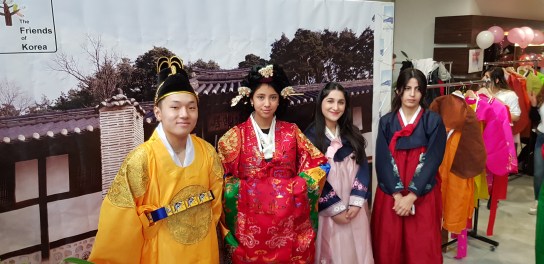
kurdish korean festival dress.jpg

jurdish pose k-pop

kurdish youth perform k-pop.jpg

ERBIL (Kurdistan 24) – The Friends of Korea, The Center For Korean Studies, and the University of Kurdistan – Hewler (UKH) organized the third Korean Festival on Saturday to introduce Korean culture to people in the region as well as strengthen ties between the Kurdistan Region and South Korea.

The UKH campus was host to the cultural festival with a large attendance of mainly young people.

Various activities and competitions were organized at the festival, including a youth talent show, comprising of Korean pop music (K-pop) dance performances, face painting, name drawing in Korean, and Korean instruments and customs.

The event also showcased Korean artwork and a Taekwondo performance by the Kurdish Taekwondo Tigers.

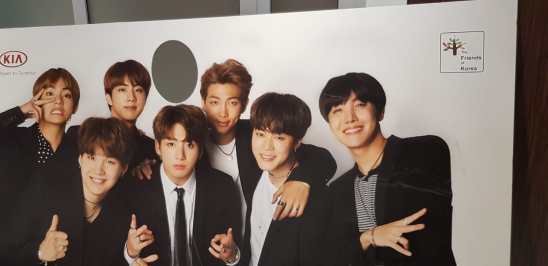
BTS , by the way, was in Saudi Arabia in October around the same time I wanted to look up something that had happened there on Twitter and my phone nearly blew up from the sheer power of K-Pop fandom. It’s real.

So anyway, in general, one should not generalize about cultures in certain ways; appreciation is one thing, but one shouldn’t take that to mean a conflation of cultures.

On the other hand:

Rangin, 27, a volunteer with the Friends of Korea, dressed in traditional Korean clothes. She told Kurdistan 24 that she had loved South Korean culture since she was young.

“South Korea and Kurdistan are very close in their culture,” she said. “That’s why I think all Kurds love South Korea.”

While cultural appropriation is a thing and a concern for a lot of people, it’s interesting to see here expressed this notion of a cultural resonance.

So how did this begin?

Sruud Yassin, 28, another volunteer, told Kurdistan 24 that South Korea has been “helpful to the Kurdistan Region.”

Relations were developed between the two nations when South Korea began to provide humanitarian assistance to the autonomous Kurdish region in the education, health, infrastructure, and economic sector since 2004.

Furthermore, the Korean Zaytun Army Division was based in the Kurdistan Region for over five years. South Korea had also previously built the Zaytun Library in the Sami Abdulrahman Park as a gift to the Kurds, with thousands of books available in different languages.

According to Yassin, the Kurdish people and South Koreans “have been friends” since then.

So the South Koreans came to Iraq to help the Kurds fight ISIS and, given their histories, traditions, and how they shaped their cultures, well, sounds like:

Game recognize Game.

basketball tom brady michael jordan

What else?

However, the political and military relationship between the Kurdistan Region and South Korea is not the only reason Korean culture has become popular in Kurdistan.

Historical Korean drama series such as the “Korean Kingdom of Wings” and “Dong Yi” have become huge hits on Kurdish TV stations for years.

Through “listening to music and watching series,” Kurdish appreciation has grown for Korean culture, Yassin said.

Mohammed Sirwan, 20, another volunteer, told Kurdistan 24 he learned about South Korea through drama series on television.

“I was watching their drama [series], like many other Kurds,” Sirwan said.

“I have been learning Korean, Korean writing, and Korean language for a long time,” he added.

So Kurds are way into South Korean shows, specifically period pieces, much like Americans watching the various flavors of “British” period pieces (i.e. the crown and colonized peoples, also embedded in their respective narratives, as with the Irish, the Scotties, etc. I don’t know anything about the Welsh but I would bet on it.) and the royal courts thereof.

So it’s similar. But  here it’s Kurds with Korean culture, so same, yet different.

But it definitely makes sense. And it makes sense that there would be reciprocation.

If all this makes sense already that there is a cultural resonance, then consider their respective relationships to the dominant power: the U. S. of A.

VOA: Trump’s Decision on Kurds Rattles Some in South Korea

U.S. President Donald Trump’s decision to withdraw U.S. forces from Syria amid a Turkish onslaught is being watched closely in South Korea, where Trump has long hinted at a major military realignment.

Trump has been accused of abandoning the Kurds, who helped the United States fight against Islamic State, by removing 1,000 U.S. troops from northern Syria as Turkey carried out a long-planned offensive against Kurdish fighters.

Trump insists he is only trying to fulfill a campaign promise to remove U.S. troops from overseas entanglements, framing the Syria decision as a pushback against U.S. officials and pundits who support what he calls “endless wars.”

That kind of talk is especially relevant for South Korea, which has been in a technical state of war with North Korea since the 1950s and hosts over 28,000 U.S. troops.

Trump has criticized the U.S.-South Korea alliance for decades, but the relationship has grown more tense as Trump’s negotiators engage in talks aimed at getting Seoul to pay substantially more for the cost of the U.S. military presence in South Korea.

Though there are significant differences in the situations facing the Kurds and the South Koreans, some in Seoul fear Trump’s Syria decision could offer a preview of what he intends to eventually do in Korea.

“It certainly sends a message to South Korea regarding cost-sharing talks: past loyalty means nothing,” said Jeffrey Robertson, a professor who specializes in South Korean diplomacy at Seoul’s Yonsei University.

Yup. That just makes too much fucking sense.

And this is why it makes so much fucking sense that Erdogan, if he wants to be rid of these turbulent Kurds, a people in many ways defined by perseverance—Dare I say, indomitable spirit?—then he would focus, among other things, on trying to stomp their culture into oblivion.

And so it goes. I mean, he even goes after the potential propagation of their culture internationally—and I guess NATO is there to help, as per usual.

So yeah, Erdogan wants to destroy Kurdish culture.

Typical.

In fairness, he’s kinda indifferent to elements of Turkish history and cultural legacy that don’t serve his purposes too.

HASANKEYF, Turkey — The time had finally come for Ramsiz Alcin to leave, generations after her ancestors settled in this ancient town on the Tigris, decades after the state proposed building a dam down river and after years of protests that had ultimately failed to stop it.

The dam would leave Hasankeyf almost totally submerged.

Now, granted, the plan has been in place for ages. But it was put in place back when many peoples were enthralled with modernity and there less value came to be placed on historical legacies and their artifacts. There were even cultural purges of benighted pasts by many regimes around the world.

Since then, we’ve discovered that that was a bit like Bart Simpson trying to get a new and improved dog and realizing the experience of dogness with the “better” dog was not superior; there is value in connection. Burke and Oakeshott were right about that.

Of course, theirs is not a politics for a people in crisis. And lots of peoples find themselves in crisis. From time to time.

So it’s pretty clear Erdogan doesn’t give a shit about Turkish culture except when he’s manipulating it for popular support.

So it makes sense, as per all of the above, that he would want to extinguish a culture so defined by resistance—and let’s not forget:

footloose ovie poster

Right. Dancing.

But I expect that Erdogan is more concerned with the resistance part with the Kurds. And I dare say the rest of the people of Rojava at this point; I mean, they’ve managed to still be there after all. Cultures of resistance tend to survive or, at least, have the proverbial puncher’s chance; the concepts sorta go hand in hand.

So, I saw something on Twitter, something in Rojava—not Kurdish, but of Rojava.  And, in keeping with the cultural trends I’ve noticed that extend beyond ethnicity (nobody has a monopoly on resistance), various people seemed to think was funny and cool.

I didn’t get it. And I couldn’t figure out why.

Once it was explained to me, though, I thought of all this.

Not to put too fine a point on it, it just reminded me of some of the stylized hyper-modern-tech with post-modernity-on-overdrive thematic elements and innovative twists or something exceedingly complicated like that.

It’s some late stage, advanced stuff. And lots of Korean culture is kinda a lot like that.

Which brings us to Tik-Tok.

I saw some videos on Twitter and I didn’t get why there were supposed to be funny or cool or, really, different and special.

The one defining feature that stood out as different from other videos was that it was this Tik-Tok thing. I googled it and really couldn’t figure out why anyone would use a video app on a smart phone that already had video.

So I asked the message board—the same one this blog originated on and where it still continues. And so I started a thread: Tik-Tok: Why??

If you’re still reading, just bear with me a tiny bit longer: The information comes, but the board has a communicative style all it’s own.

This will make sense, I swear. Here’s how the conservation went.

Reverend

Why did people need a new video app for smart phones that already do video?

I honestly can’t figure out why people are using it. Or what it offers people such that they use it, or any certain types of people use it. Or any of it really.

Little help?

DJnVa

I thought this was about Ke$ha

https://youtu.be/iP6XpLQM2Cs

Reverend

It is now, brother.

DJnVa

It’s instagram for videos. Kinda.

Reverend

Then what the fuck is InstaGram?

I feel old. Like I’m about to turn to dust or something.

Darnell’s Son

OK, boomer… or something.

DJnVa

It’s Tik Tok for pictures.

Reverend

Well played.

You used the cocktail stick, didn’t you?

DJnVa

Every damn time.

Reverend

Why are people using it? Just because it’s new? To migrate away to a new platform that doesn’t have their parents? Etc.?

InstaFace

Yes. Kids show each other something funny on their phones, look cool to their peers, ask where they got it, and download that app so they can use it themselves. It’s not any more complicated than that. They don’t care what the older kids or parents have installed on their phones, or whether they already have something installed that could accomplish that same task. They just want the funny thing their cooler friend showed them. You want to start a new Facebook clone, just write features for following and sharing, get some critical mass of 13-year-olds to try it simultaneously, and make some content they find amusing to show each other. Social media platforms are only as sticky, it turns out, as the extent to which they are the originating point for the most viral content on the web. If 4chan or SomethingAwful were profit-maximizing businesses, they’d rule the internets.
Reverend

Thank you. Lots. This makes sense.

canderson

It’s funny because it’s China very likely stealing everyone’s info.

darnedsox

exactly tick,tick,tick…….

Tangled Up In Red

It also allows kids a lot of freedom of expression, just from its ethos. It isn’t rooted in ‘curated’ perfection, it is based on experimentation – with humor, dance comedy, copy-cat, etc. It is a platform that seemingly affords many the ability to be ‘viral’, as follower count isn’t a requisite to being seen. You can be in anyone’s feed (permissions, of course), so long as the alogorthim selects your content.
My dog has 200 views on a video and has no followers.
Fwiw.

Reverend (“cross-posting to another thread on the message board)

OK, other posters were kind enough to explain Tik-Tok to me, which I needed to know to understand why this was funny.

Thanks again. Seriously—I was really confused because I only saw the video on Twitter and didn’t know why it was significant. War is hell, clearly.

barbed wire Bob

You have a weird definition of the word “funny.”

Reverend

Technically, I’m using their working definition. But people seem to love their social media game.

I guess being the hip edgy militia is their thing? Way more punk rock than those other fuddy duddy counterinsurgency forces.

Exeunt

And that’s how I came to think: This is an over-generalization, but damn, I bet a lot of Koreans would really enjoy that video. 


Dec 01 (1/2): The M4 Highway: Build that Wall!

Oh my fucking God they are building a fucking wall.

I mean, more is going on, but I didn’t want to bury the lede on this one.

So how did this come to pass? I mean, building a wall is a strange thing to do in a combat zone. I’m not saying it doesn’t make sense, I just mean that it’s hard to do and, like, really, really dangerous. People are often amused by Hobbes’s “nasty, brutish, and short,” line as representing life in the state of nature, but what he means is that without a stable political situation, life is too uncertain to do much of anything, least of all build shit that which some jerk will inevitably knock down when you’re not looking.

So, to reiterate: The hell? First, word came of a meeting.

Actually, no. First shit like this Tweet thread started.

which caused pretty much exactly the reaction you might expect.

woofers news open M4 12-01-19

WHO THE FUCK VAGUEBOOKS A WAR???

So anyway, it was announced that there was a big meeting between Gen. Alexander Chaiko of the Russian forces in Syria and Gen. Mazloum of the SDF.

Here’s the notice that went out.

Wait, if you’re reading this, you probably can’t read that. I can’t either. Let’s try again.

Whoops, no. You know what? They didn’t put the notice out in English, just Russian and Arabic.

That’s cold, yo. Anyway, we can get a translation.

Of course, everybody already knew what had been decided long before the announcement.

Still, was the VagueBooking really necessary?

Fine. Be like that.

Actually, it’s cool. He really does get the goods. Good follow.

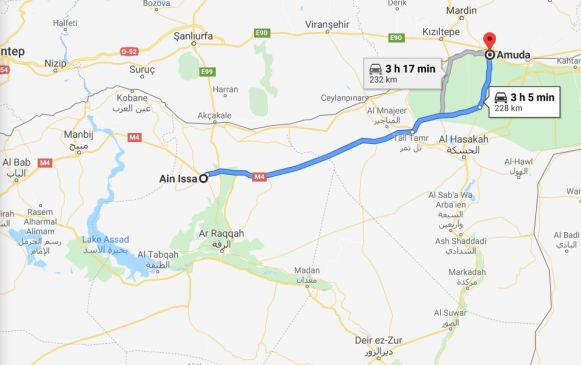
So yeah, there was a big deal finalized whereby the Turkish backed militia withdraw a bit north from the M4 highway along that critical stretch between Tal Tamr and Ayn Issa, and Russian and SAA troops will take over patrolling that territory, in addition to a Russian base up north east in Amuda.

map ain issa tal tamr amuda

South Front: SDF COMMANDER-IN-CHIEF ANNOUNCED DEPLOYMENT OF RUSSIAN TROOPS IN TELL TAMR, AYN ISSA, AMUDA… IN RUSSIAN

Chances of a possible Russian withdrawal from the Turkish border and the resumption of the Turkish military operation against Kurdish armed groups seem to be working like a charm.

Mazloum Abdi, a member of the Kurdistan Workers’ Party (designated a terrorist group in Turkey) and the commander-in-chief of the Kurdish-led Syrian Democratic Forces now speaks Russian.

On December 1, Abdi announced that the SDF and the Russian side had reached a deal under which Russian Military Police units will be deployed in Tell Tamr, Ayn Issa and Amud. The announcement was made via Twitter, in Russian.

Now, to add some detail (beyond the fact that if you map that on to where the US is, it splits Rojava in half territorily between super power presences, and that’s fun), note the mention of the silos in the Rojava Network Tweet above. I forgot to mention this in the Deep Operation post the other day, but it fits into both the large scale strategic assault on the economy and the more micro-oriented random violence and making it a terrible place to live thing, and how things like shelling the water station do both.

Anyway, as the main highway spanning the area, the M4 is obviously critical to transportation. Which means there would be—are—grain silos along the route, like, pretty much everyplace where people have food they need to move around, be it along rivers or major thoroughfares. It’s just the kind of stuff you get near major transportation corridors like the M4: grain silos.

So equally obviously, the TFSA guys have been stealing the grain. That’s just what they do. Hurts the people. Hurts the economy. Stealing bread from people is a classic bad guy move in stories, going back even before stealing bread, when everyone made their own bread, it was all about stealing the grain. Which is to say, the Turkish backed militia guys are basically medieval.

And they’ve been doing it for awhile.

So, broad view, Russia is taking over the policing of a new and expanded portion of Rojava (Wait? Hasn’t this happened before? Uh…) including the critical part of the M4 between Ain Issa and Tal Tamr and, notably, a base up north on the border a few clicks to the west of Qamishli where the US is setting up bases.

So the M4 will be maintained by Russia and Assad’s regime, and the silos will remain with Rojava.

So, circling back, as we allegedly know from that one Robert Frost poem, the only one which might have its meaning as commonly butchered as the one about the path less traveled: We’re apparently going to need a fucking wall to make this work.

Who could have seen this coming?

Interesting. But the way Tweets embed on WordPress, you can’t see the key information: The date.

Let’s look closer.

enhance super troopers.gif

Oh.

Seriously, what the fuck is going on here?

Nov 30 (2/2): Talking Turkey. And Politics

So let’s check in with Turkey—a bit of a news round-up, if you will.

As per the larger picture, it seems Turkey is moving further into Russia’s orbit. That just makes sense; Russia has a lot of gravity.

Ahval: Turkey becoming captive to Russia as Western sanctions loom

Turkey is still struggling through an economic downturn which the government’s foreign policy could make worse by risking sanctions from the West while making the country extremely reliant on Russia.

Repeating a call he made when Turkey was in the depths of a currency crisis sparked by limited U.S. sanctions last year, President Recep Tayyip Erdoğan told citizens this week to deal in the Turkish lira and not foreign currencies – a sure sign of economic trouble ahead.

When the currency crisis hit after Washington sanctioned Turkish ministers over the imprisonment of a U.S. pastor in August 2018, Erdoğan described support for the lira as a national duty. Yet central bank figures announced on Nov. 15 show that foreign currency savings in Turkey had increased by $36 billion to $225.5 billion in the past year.

I mean, it has to make sense on some level. Because it’s happening.

But despite becoming a Russian puppet state, Turkey still has bold plans for the future.

Ahval: Turkey to bring peace to the Middle East, says interior minister

Turkey will transform the Middle East into a peaceful geography as it did in the country’s predominantly Kurdish eastern and southeastern regions, Turkish Interior Minister Süleyman Soylu said on Saturday.

Soylu called out countries looking to stir trouble in the Middle East, promising Kurdish, Arab, Alevi, Sunni people that Turkey will transform the region during a speech he delivered in the country’s southeastern province of Adıyaman, Karar newspaper reported.

“It is Turkey and this nation that will turn the Middle East into a land of peace,’’ Soylu said. “We will achieve this all together, through protecting brotherhood”.

Pretty bold puppet there. Maybe agree to disagree on this one?

You can’t be serious.

BBC: Turkey’s charismatic pro-Islamic leader

But his pro-Islamist sympathies earned him a conviction in 1998 for inciting religious hatred.

He had publicly read an Islamic poem including the lines: “The mosques are our barracks, the domes our helmets, the minarets our bayonets and the faithful our soldiers…”

He was sentenced to 10 months in jail, but was freed after four.

However, because of his criminal record, he was barred from standing in elections or holding political office.

Parliament last year changed the constitution to allow Mr Erdogan to stand for a parliamentary seat.

Well, that explains that stuff the Kurds were putting out about being Muslim too, but, y’know, not like that guy.

wayne's world seemed extraneous at the time

But yeah, it’s an important part of their theory of politics, and not a small part of why’re they’re being targeted in this conflict: This is not an ethnic or even a national thing. It’s a freedom thing.

So obviously it’s unpopular with Erodgan; that’s not really his thing, yeah?

Reuters: With more Islamic schooling, Erdogan aims to reshape Turkey

Turkey’s president has said he wants to create a “pious generation” to change the nation. So the government is pouring money into schools that teach Islamic values.

Well, pious isn’t so bad. And it’s a thing in all the Abrahamic religions, to say nothing, of, well, most of them for that matter.

So anyway, how bad can piety be?

Erdogan has said one of his goals is to forge a “pious generation” in predominantly Muslim Turkey “that will work for the construction of a new civilisation.” His recent speeches have emphasised Turkey’s Ottoman history and domestic achievements over Western ideas and influences. Reviving Imam Hatip, or Imam and Preacher, schools is part of Erdogan’s drive to put religion at the heart of national life after decades of secular dominance, and his old school is just one beneficiary of a government programme to pump billions of dollars into religious education.

And Erdogan’s gonna be in charge of this?

Washington Times: Erdogan and the meaning of Hitler
The Turkish president’s revealing slip of the tongue

It’s one of those questions political science majors debate over too many beers at the college pub: Which is better, a parliamentary system or a government headed by a powerful chief executive?

Turkish President Recep Tayyip Erdogan was asked that question last week. He replied that he was inclined toward the latter, noting that there “are examples in the world” that have worked rather well. One sprang to mind: “You can see it when you look at Hitler’s Germany,” he said.

Wait, can we even go there?

Dan Savage: Godwin Suspends Godwin’s Law

Godwin’s Law:

American attorney and author Mike Godwin coined his eponymous law on Usenet in 1990. Godwin’s law (or Godwin’s rule of Hitler analogies) is an internet adage asserting that “As an online discussion grows longer, the probability of a comparison involving Hitler approaches 1”; that is, if an online discussion (regardless of topic or scope) goes on long enough, sooner or later someone will compare someone or something to Adolf Hitler or his deeds. Promulgated by the American attorney and author Mike Godwin in 1990…. [There] is a tradition in many newsgroups and other Internet discussion forums that, when a Hitler comparison is made, the thread is finished and whoever made the comparison loses whatever debate is in progress.

So those are the rules.

OK, I guess we’re settled then. Maybe hold off on that agree-to disagree-thing, I guess, huh?

Erdy’s probably busy though; lots of things to do.

eddie-izzard-someones-killed-100-000-people-were-almost-going-well-quote-on-storemypic-21699

I suppose there could still be freedom in an Ottoman society. It was pretty advanced.

Ahval: Turkish court orders investigation of leftist journalists for reporting leaks

Economist: Turkey leads the world in jailed journalists
Just five countries account for 70% of all reporters in prison

Free press is one of those conditions of liberal democracy. I guess Turkey’s not into that particular political fad. I bet that’s not great for politics in general, really.

What would Erdogan want to hide from the public, I wonder.

Well, that’s interesting. So is this.

Ahval: Erdoğan’s Istanbul dream may be dying

As he sought to position Turkey as the leader of the Muslim world, Erdoğan approved $100 billion worth of megaprojects to make his lighthouse shine bright. These included the world’s largest airport, Turkey’s largest mosque, a multi-billion-dollar financial center, a third bridge over the Bosphorus, as well as railway and road tunnels underneath it, and a 30-mile shipping canal linking the Black and Marmara seas that Erdoğan himself described as crazy.

Fast forward six years, and the president’s mission seems to be teetering. The surest sign of this was his party’s loss of the Istanbul municipality to the main opposition candidate in local elections this year.

Not only has Erdoğan lost control of the municipality that his ruling Justice and Development Party (AKP) and its predecessors had run since he became mayor 25 years ago, but they have also left the city $5 billion in debt.

Sounds like he’s not on the firmest of grounds at home.

batman begins sure footing killing stroke.gif

So looks like there’s lots of trouble for Erdogan at home; more than I realized. I figure he’s going to have to shore things up at home, yeah? Maybe address some of those ole domestic problems?

Or not.

So let’s revisit this.

Holy crap that’s funny.

This guy is going to bring peace to the middle east. Right. Erdogan is the guy that the middle east is going to rally around.

It makes sense he’d think so. I mean, he thinks he’s going to wipe out the Yazidi and people have been trying to do that since time was invented.

Erdogan doesn’t triage very well.

Well, at least he knows he won’t get any push-back from NATO.

Yeah, you tell’em Erdy. They know what’s what now, right?

Maybe they finally do.

Arab News: Erdogan faces NATO ire on eve of summit

ANKARA: Turkish President Recep Tayyip Erdogan faces a hostile reception from fellow NATO members at the alliance’s summit this week in London, analysts told Arab News on Saturday.

Days before a NATO summit in London on Dec. 3-4, the Turkish and French presidents have engaged in a battle of words.

. . .

Following harsh comments from the Turkish side, France summoned Turkey’s ambassador to Paris to protest over what it viewed as an “insult” rather than a “statement.”

A French presidential adviser also criticized Turkey, claiming “Ankara cannot take the defense plans of Poland and the Baltic countries hostage.”

The exchange of criticism reflects the tension between the two NATO allies before the approaching meeting where they are expected to hold a four-way summit, along with German and British leaders, to discuss the fate of Syria.
According to a recent Reuters report, Ankara has one condition to back the NATO plan: Securing more political support from the alliance over its fight against Syrian Kurdish YPG militia in northern Syria.

French intellectuals also reacted harshly to Erdogan’s remarks about Macron.

“Macron ‘mentally ill’? Indeed, from the point of view of Erdogan, defending the Kurds, leaving its opponents at liberty, respect democracy, be faithful to its international commitments and humanitarian law, it’s pure madness,” French philosopher Bernard-Henri Levy tweeted.

. . .

“Ankara thinks it can extend its suppression of criticism at home to a suppression of criticism from abroad. It cannot. With its actions in Syria, in the eastern Mediterranean, in its agreement with Libya on maritime boundaries that threatens Greece, in its S-400 purchase and wider relationship with Russia, in its threats to weaponize refugees, its arrest of Germany’s lawyer, Turkey is losing and has lost sympathy in Europe,” he added.

I always forget that French philosophers get involved with real stuff over there.

Maybe don’t call the head of their government a terrorist, eh?

altered beast

But wait, what? Turkey did what in the who now? The Mediterranean?

Ahval: Turkey-Libya agreement bears consequences for Greece – analyst

The agreement signed on Thursday by Ankara and Libya’s internationally recognised Government of National Accord (GNA) government to redefine Turkey’s maritime borders is part of a plan Ankara to gain superficial legitimacy in order to move in on the  Eastern Mediterranean, Angelos Syrigos, associate professor of international law and foreign policy at Athens’ Panteion University, wrote in Katherimini on Saturday.

. . .

The agreement signed on Thursday could create a wall preventing Greece from developing its sovereign rights in the eastern Mediterranean continental shelf, the article said, adding this would effectively confirm Ankara’s years-long narrative ‘’that the islands are not entitled to a continental shelf under law’’.

Despite being illegal, the article said, the deal with the GNA can only be overturned if Libya backs out of the agreement or by recourse to international justice, the latter which Ankara would never accept.

It just. Does. Not. End with this guy.

Ahval: Turkey’s game in east Mediterranean has just started, says Yeni Şafak

Turkey has defeated plots in the eastern Mediterranean and has now started its own game by striking a deal with the internationally recognised government in Libya which, if implemented, will make the two countries maritime neighbours, Turkish daily Yeni Şafak said on Friday.

Defeated plots? Ha! I knew Erdogan thought he was COBRA Commander.

cobra commander

The extended Turkish EEZ, which Ankara calls “Blue Homeland”, will provide Turkey a competitive dominance in the east Mediterranean energy dispute, Yeni Şafak said. Turkey now has the required legal grounds for rights which it had so far protected through its navy, it said.

Yeah? We’ll see.

At least I bet he has a nice crib to kick it in while he waits for whatever’s gonna happen with this war thing. I mean, I’m not a shring, so this is not a medical opinion, but I’m thinking narcissistic personality disorder.

But he did endorse piety, which usually involves some sort of self-abnegation, so maybe something like this?

good place here's your house

Probably not. I mean, given the times, a dictator has to keep up with the Joneses, yeah?

Ahval: Erdoğan’s presidential complex to receive further budget hike in 2020

Turkey’s ruling Justice and Development Party (AKP) has proposed an 11.8 percent budget increase for the Presidential Palace in Ankara for a total of 3.15 billion lira ($548 million) in 2020, Cumhuriyet newspaper reported.

The budget increase for next year in the 1150-room presidential complex in the Turkish capital Ankara, follows a budget hike from 1.6 billion lira  ($ 278 million) in 2018 to 2.8 billion lira ($ 487 million)  in 2019, Cumhuriyet said.

Presidential expenditures since Recep Tayyip Erdoğan took office in 2014 have increased by at least 550 percent.

The majority of Turkey’s 2019 budget allocations were spared for presidential, security and defence expenditures.

That’s kinda absurd. I mean, how does he does he get away with this crap? It doesn’t seem like anyone actually likes him.

cobra comander lego

You know who I’ve heard really, really doesn’t like him?

Kurditan24: Americans’ support for Kurds helps explain Trump’s Syrian reversal

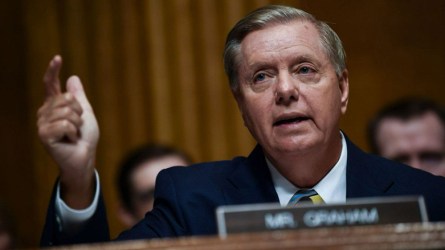
lindsey Graham 11-30-19

WASHINGTON DC (Kurdistan 24) – Sen. Lindsey Graham (R, South Carolina), one of President Donald Trump’s closest allies in the US Congress, spoke with unusual candor about Trump’s shifting positions on northeast Syria, including the most recent twist: his decision to leave some US forces to ensure that the oil fields do not fall into hostile hands.

Speaking on Nov. 20 at the annual dinner of the Jewish Institute for National Security of America (JINSA), which honored the Senator with an award for his many years of public service, Graham described an important domestic political consideration involved in that decision: the views of conservative Christians.

Conservative Christians strongly opposed what they (and many others) saw as Trump abandoning America’s Kurdish allies, by withdrawing US troops and allowing Turkey to attack across its southern border.

The President was “sort of surprised,” Graham explained, “that people didn’t stand up and cheer, when he said, we’re getting out of Syria.”

Even more, significant groups opposed the decision, and “the pushback from the Christian conservative community about us abandoning the Kurds was overwhelming,” Graham said.

OH HAI LINDSEY!!


Nov 30 (1/2): Today in the Fight against ISIS

candylandriots

The last thing I want to do is over-summarizeb ut having now read all of the above myself, a couple of the links (extracted from Twitter) and one thing Rev wrote struck me as particularly important.

Drone footage of Damascus and Aleppo

NY Times Review of Books on who are Turkey’s proxies in Syria

Operation Peace Spring in northern Syria

Reverend

Major state actors are in coordination on an integrated operation (or set of operations) to separate Rojava from the support of the international community as part of an effort to wage war on every level. Indeed, even the “lull” is a form of misdirection to get us to focus on a reduction of kinetic violence and take our eyes off of the “lower level” violence that sows the seeds of terror and the higher level, almost invisible, global political machinations at the state level

There’s less artillery shelling, perhaps. But that disguises the fact that there is more war. Indeed, the war is total. Heck, we’ve even seen Turkey trying to eradicate the Kurdish language and, indeed, culture itself. That’s what total war means. That totality just happens to be much larger than our conventional conception of war, i.e. the stuff we can watch easily on TV.

And in the big picture, it looks like Turkey is fighting a proxy war against Rojava using ISIS, and Russia is fighting a performative proxy war against NATO using the whole of the fucking war in Syria

Reverend

It’s been an interesting day on the Twitters. I think so anyway. But, I mean, it’s Twitter.

turkey isis militia

This is older, but it showed up today; hadn’t seen it before.

Al-Monitor: IS designates Turkey as its next base

Turkey — the logistics lifeline of jihadi movements in Iraq and Syria — has failed to clear its own backyard of jihadi threats. There are credible indications that the Islamic State (IS), after losing its territorial dominance in Iraq and Syria, has designated Turkey as its next reorganization base.

. . .

Iraqi intelligence sources have provided solid information that the brains of IS have moved to Turkey. The United States has tracked the jewelry shops and foreign currency exchanges used by IS in money transfers. The US Treasury Department on Sept. 10 placed al-Haram, al-Hebo, al-Khalidi and Saksouk foreign exchange bureaus and jewelry outlets on its sanctions list for transferring money for IS.

The people of Rojava are out in force now, too. Despite there being a war on and stuff.

And then a surprising amount of… dancing?

Another day of… I dunno, contradictions? Harmony of contradictions? Drums and bass? Celtic music over African beats? (That was some peak internet, IMO. I dunno. The place is wild.

Like, it stands out even on a day where, to borrow from a buddy of mine:

Spelunker

This might be the single most badass civic engagement moment in human history. An immigrant plebe grabs a unicorn’s horn to fend off someone attacking his adopted country?

This should be a musical. Lin-Manuel Miranda has his new muse.

Rojava is somehow still more lit. Probably the only thing in the world more postmodern right now, too.

I mean, seriously:

Who VagueBooks a war??

This really is a badass moment in the history of civic engagement.

Nov 29: Total War on Rojava: Deep Operation

So I wanted to look at how the war works in ways beyond the obvious fighting. I mentioned how the terrorist bombings were a feature of the apparent lull in military operations to further the belief in the populace that life there is indeed now unbearable.

To really understand the lull in the fighting, though, we need to understand how that’s only the visible manifestation of war; war has become far more involved than what is now often referred to as the “kinetic” portion, i.e. the shooting and shelling and stuff.

batman ras al ghul weapons more sophisticated

To this end, it makes sense here to revisit the Russian theory of deep operation (wiki).

Deep operation (RussianГлубокая операцияglubokaya operatsiya), also known as Soviet Deep Battle, was a military theory developed by the Soviet Union for its armed forces during the 1920s and 1930s. It was a tenet that emphasized destroying, suppressing or disorganizing enemy forces not only at the line of contact, but throughout the depth of the battlefield.

The term comes from Vladimir Triandafillov, an influential military writer, who worked with others to create a military strategy with its own specialized operational art and tactics. The concept of deep operations was a national strategy, tailored to the economiccultural and geopolitical position of the Soviet Union. In the aftermath of several failures or defeats in the Russo-Japanese WarFirst World War and Polish–Soviet War, the Soviet High Command (Stavka) focused on developing new methods for the conduct of war. This new approach considered military strategy and tactics, but also introduced a new intermediate level of military art: operations. The Soviet Union was the first country to officially distinguish the third level of military thinking which occupied the position between strategy and tactics.[1]

Using these templates, the Soviets developed the concept of deep battle and by 1936 it had become part of the Red Army Field Regulations. Deep operations had two phases: the tactical deep battle, followed by the exploitation of tactical success, known as the conduct of deep battle operations. Deep battle envisaged the breaking of the enemy’s forward defenses, or tactical zones, through combined arms assaults, which would be followed up by fresh uncommitted mobile operational reserves sent to exploit the strategic depth of an enemy front. The goal of a deep operation was to inflict a decisive strategic defeat on the enemy’s logistical abilities and render the defence of their front more difficult, impossible—or, indeed, irrelevant. Unlike most other doctrines, deep battle stressed combined arms cooperation at all levels: strategic, operational, and tactical.

This is to say that there is a lot more that goes on in a war than what we identify as the war on television.

Note also that this theory, while very modern, goes back a long time. This kind of approach to war has developed a great deal over time and while I don’t know all the terminology, we know that a great number of tools have been added to the proverbial kit.

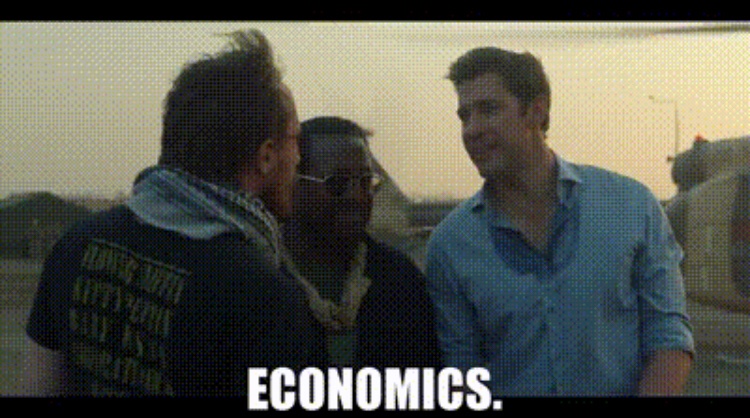
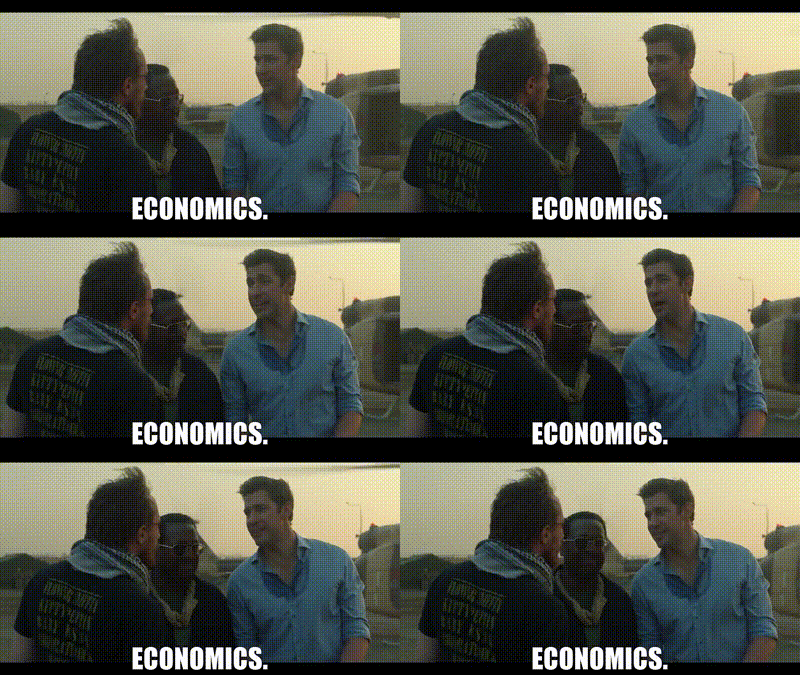
batman economics

So let’s begin by looking at a few issues of the economic component of the war, and then see how looking at what I’ll call here the “macro view” of the war offers additional insight into what is going on.

ECONOMICS

We’ve talked in the past about how vital control of the M4 highway across northern Syria is not just for reasons of troop movements, but also because of the impact it has on the economy if the occupying forces can control the movement of people, goods, services, etc.

The hit to the economy must be understood not as a happy side effect for the invading force that comes with control the highway, but rather as a critical element of the attack.

This fact comes into greater focus when thought of in the context of other more direct attacks on the infrastructure of the region; that is to say, much more is attacked than just military installations, and that gives us a sense of the purposes and how they relate to the larger objectives of the war.

Which is why Turkey does things like attack the water supply in Rojava.

RIC: ‘The water will not last more than a month’: Northeast Syria faces critical water shortage

AMMAN— Northeast Syria is facing an acute water shortage as a result of damage to civilian water infrastructure and the roughly 108,000 Internally Displaced Peoples (IDPs) who fled the Turkish offensive, “Operation Peace Spring,” early last month.

https://twitter.com/RojavaIC/status/1189210085630849024?s=20

If you think about it, hitting the water supply offers huge bang for the buck in terms of pressing an attack like this. I mean, it’s a fucked up thing to do. But it makes sense, in this context.

Just like, if you want to really cripple a population with damage and fear, shooting health and rescue workers makes sense too.

This is a bit of an aside, but I keep feeling sheepish for worrying early on that RIC might not be a reliable source. Now I understand that not only, as per above, are they about a month ahead of CNN, they’re now literally fucking helping CNN after I don’t know how long of offering their services to the world in covering this conflict.

So, Turkey’s interfering with travel, hitting key infrastructure points like water facilities and medical institutions.

Once we see how that all fits together into an integrated way, then we can understand it all as part of a larger attack. Like, say, on the whole economy of the region.

NPA Syria: Economic crisis targets people s food, salaries increase must contribute in prices control – Economic expert

In a special statement to North-Press, the economic expert, Dr. Fadi Ayyash described the economic crisis which Syria is undergoing with the imposed war on the country, but in another way, “because it targets the food of the Syrian people.” Ayyash said that, the economy and the economic sanctions are the last paper pressure which is used by “the opposing forces” of the Syrian people, “for the imposed war on the country for years, began choosing another way, it is facing the Syrian State outwardly, but inwardly it is targeting the Syrian people”.

He added that, the economic war is the most devastating war and the most affecting war on society, and the main reason is that, its mechanisms are vague for the society. “people’s sustenance is the most affected by such policies which reflects the purchasing power. So, it reflects on the general trading process of the country, which begins from the factory, to the market, to the exports and imports, and this is one of the kinds of the direct pressure on the economic policies of the state and on the people’s sustenance”.

“Economic expert.” Nice. He must have sweet business cards.

This paper is available in its entirety online. I’ll print the abstract below, but it should be noted that this was written almost two years ago.

Struggling to Perform the State: The Politics of Bread in the Syrian Civil War (International Political Sociology June 2017)

Abstract

Recent studies of civil war have problematized frameworks that rely on a strict binary between state-sanctioned order and anarchy. This paper extends these insights and combines them with theories of performativity to examine welfare practices during the Syrian conflict (2011–2015). Specifically, we argue that conceptualizing the state as a construct—as an effect of power—can expand the study of civil war beyond its quantifiable aspects and embrace the performative dimensions of political life. By means of everyday, iterative acts such as welfare provision, competing groups summon the state, and the political order it seeks to enshrine, into existence: they make it both tangible and thinkable. During civil war, the ability to perform these prosaic acts becomes a matter of pressing military and political concern. Through close scrutiny of various cases, we dissect the impact of subsidized bread provision by the Assad regime, the Free Syrian Army, and armed Islamist groups as they struggle to perform the state. Our aim is to bring attention to under-studied governance practices so as to analyze the otherwise opaque relations between welfare provision, military success, and civilian agency during Syria’s civil war.

So the war is really being fought in terms of a war on frickin’ everything. It’s not just combat units shooting at one another, but the destruction of even the larger things we can only abstractly conceptualize, like “the economy.”

jack ryan economics

This means it makes sense to look at the war on the place of Rojava in the international community. If we’re looking at how a state (or “proto state” in the case of Rojava, as it is technically called because it has never been recognized by another recognized state. So I guess no blue check for Rojava.) fights a war, the operation will occur at the level of state maneuvering.

Which is what we see.

The Neutralization of the West

If you’re Turkey, or for that matter, Syria or Russia, it makes sense to marginalize and disconnect Rojava from the support of the world community to head off the possibility of them coming to Rojava’s aid.

Ultimately, what Turkey wants to do is to establish that they are a more important ally to anyone who might otherwise support Rojava than Rojava is.

RUDAW: Europe should condemn Turkey’s wrongdoing, but relations must not end: German official

That is a fantastic short Q&A about a lot of what is going on and what the view from Germany is like.

It also contains this gem:

The German government still enjoys good relations with Ankara. Why does it not use its influence to make Turkey abandon actions that Europe is unhappy with, and disagrees with?

What has really frightened us and concerned us is that Turkey has accelerated torture [of inmates], and it has become a phenomenon. We have information about many cases [of inmates] who suddenly disappeared and remain missing. This is a dangerous trend.

We have exerted mounting pressure on Turkey. The halt of arms sale is one of the sanctions we have imposed on Ankara, but we do not have to severe our ties. Turkey should of course be a NATO member and be given the chance to become an EU member as well… I think it is a mistake to distance Turkey from the West and Europe. We should have clear stances, and strong criticisms, but we should not end relations with our strong ally, Turkey.

OK, so they know Turkey is acting shitty, but they still value the relationship because it’s so fucking important.

That must be really demoralizing to the people on the ground to read if they had been hoping for some support or pressure on Turkey from the west; there had been word that Germans really didn’t like what was going on in the past, but it doesn’t seem like support is forthcoming.

Ahval: Germany’s Merkel says Turkey should remain a NATO member

German Chancellor Angela Merkel said on Wednesday that Turkey should remain a NATO member despite growing differences between Ankara and its partners, Associates Press reported.

“I say that Turkey should remain a NATO member and we should support that, because it is of geo-strategic significance for NATO that Turkey is in” Merkel said while addressing the German parliament before a NATO summit in London next week.

The chancellor said that Turkey had become alienated as a member state of the alliance and labelled  “a difficult partner”.

If that looks disheartening to see that Germany clearly weighs the value of Turkey in the NATO alliance more heavily than what Turkey is doing to the people of northern Syria, imagine hearing about something like this:

TheTimesUK: Russia is no longer our enemy, Macron tells Nato before summit

President Macron set the stage for new discord in Nato by declaring that Russia was no longer the enemy of the alliance and calling for closer ties with Moscow.

Less than a week before the difficult Nato summit in Britain, the French president stuck to his widely criticised claim that the alliance was “brain dead” and in need of a strategy to replace US leadership of the continent’s defence.

So Germany favors Turkey and France wants to bring Russia into the fold.

Reading this must suck. But, well, we always know how well sucking up to bullies works, so France or Germany must be getting some kind of concession or benefit from trying to make nice, right?

Yeah, right.

The Guardian: Macron’s criticism of Syria invasion ‘sick and shallow’, says Erdoğan
Dispute between French and Turkish presidents escalates before Nato summit next week

The dispute within Nato over Turkey’s invasion of northern Syria escalated on Friday when the Turkish president, Recep Tayyip Erdoğan, responded to criticism from the French president, Emmanuel Macron, by saying that Macron needed to check whether he was brain dead.

Claiming Macron was inexperienced and did not know what terror was, Erdoğan said Macron’s criticisms of the Turkish invasion reflected “a sick and shallow understanding”.

He also warned Macron against any attempt to expel Turkey from Nato, saying it was not up to the French president.

That’s incredibly rough language for diplomatic and foreign relations stuff, and I don’t mean The Guardian refusing to put NATO in call caps. But, well, I guess at least he didn’t call the President of France a terrorist or something.

Oh wait.

BBC: Macron is a sponsor of terrorism, says Turkish foreign minister

Addressing reporters in parliament on Thursday, Mr Cavusoglu said: “He [Macron] is already the sponsor of the terrorist organisation and constantly hosts them at the Elysee. If he says his ally is the terrorist organisation… there is really nothing more to say.

“Right now, there is a void in Europe, [Macron] is trying to be its leader, but leadership comes naturally.”

Turkey was angered when Mr Macron held talks in Paris on 8 October with SDF spokeswoman Jihane Ahmed.

Mr Macron’s office said the meeting was to express France’s solidarity with the SDF in its fight against the Islamic State group, and also to reiterate concerns about the prospect of a Turkish military operation in Syria.

Woof.

And circling back, let’s remember that the partisans on the ground see all this quite obviously for what it is.

So that about covers France, but while we’re at it, I expect the Germany stuff is the reason that there are a bunch of articles popping up about the fact that Turkey gave German Leopard-2 tanks to ISIS jihadis.

There’s other stuff and in different languages going around the last couple of days, but I wanted to highlight how the Rojava Information Center is responding to the public message on this in part by reminding the world they told us about this fucking weeks ago.

Now, at this point, we already know who’s been stepping into the power vacuum created by a paralyzed NATO and a US military with a mission that… it’s complicated.

Russian Gas Lighting

https://twitter.com/rudawenglish/status/1199712478445363200?s=21

RUDAW: As ceasefire deals crumble, Turkey says Syria incursion will continue

The operation has largely come to a halt since the United States brokered a ceasefire followed by a security deal with Turkey brokered by Russia.

Clashes have continued, however, in areas like Ain Issa, the administrative capital of the Kurdish-led Autonomous Administration, and the Christian-majority town of Tel Tamr.

In its meeting, chaired by Erdogan at the Presidential Palace, the National Security Council said Turkey would continue its operation.

Turkey’s incursion “which contributes to peace and stability in the region, will continue until it reaches its goals, while taking all precautions to prevent harm to civilians”, a council statement read, according to the state-run Anadolu Agency.

Kurdish forces were compelled to withdraw from the border areas to a depth of 32 kilometers under the US and Russian-brokered deals. The Turkish council said it “expects” both the US and Russia to implement the agreements and have Kurdish-led forces removed from northern Syria, Manbij, and Tel Rifat.

“We call on the international community to support Turkey, which aims for the safe and voluntary return of Syrians to their country without any discrimination based on ethnicity or religion,” the council added.

Turkey’s operation has been widely condemned by European and American observers.

Hopefully by now, it is becoming clear that in no way has the operation come to a halt. There is less shooting. But even these statements are part of the larger operation. Here they are aimed at emphasizing Russia’s role in the conflict, which advances Russia’s interests by giving them more leverage.

Because Russian power over the situation is already quite clear.

Russia, as per deep operation theory, is not going to just establish their air power, though: They’re going to redefine the whole narrative of their role as part of their pursuit of Russian interests.

“Russia the hero.”

RUDAW: Putin praises Kurdish support for Russian forces in northern Syria

ERBIL, Kurdistan Region — Russian President Vladimir Putin said on Friday that Kurds have shown their support, kind-heartedness and love towards Russian military police who have been deployed to northern Syria to halt a Turkish offensive against Kurdish fighters.

How awesomely self-serving is that? Russia praises Kurds for loving Russia.

That’s fucking bold. Still not as bold as this.

BasNews: Putin: Success in Syria was achieved with the support of Kurdish people (Google translate link)

BasNews- Russian President Vladimir Putin said the successes achieved in Syria were also achieved with the support of the Kurdish people.

At the meeting of the Council of Ethnic Intergroup Relations in Nalchik, Russia, some Russian experts have insulted the Kurdish people and distorted history on federal television channels.

Speaking at the Ethnic Intergroup Relations Council meeting, Putin said, orum I want to underline that we have always had very good relations with the Kurdish people historically. Moreover, with the support of the Kurds in Syria and Turkey border obtained thing at the moment and is done in accordance with their interests. They understand that, and they approach it with heart. Our military police are well received in Kurdish settlements. Because people see and understand that the Russian army is coming to protect them. This is a clear fact ”.
In I don’t know who’s saying what’s there or what’s nonsense, but I think people are prudent enough to know that this has nothing to do with the position of the Russian authorities, Put Putin said.

Selfless Russia and her noble relations with and role as champion of the Kurds. It’s a lovely story. Great success.

Some people remember it differently.

Granted, the people who lived on the border mellowed a bit on the Russian patrols and started only stoning the Turkish vehicles, but that can be seen in the context of resigning themselves to Russia’s role as power broker in the region once the US withdrew. As per usual, the people on the ground get it.

So like with demand and supply in economics, Russia is pushing itself and its role vis-a-vis Rojava and increasing the demand for its “services,” while at the same time, Russia and Turkey are also attempting to reduce the supply of other options, both by diminishing the possibility of support from western nations as per above, but also by truncating the range of options, or, failing that, the perception of what options are available.

Truncated Options

Already, we’ve been seeing that the range of options have been increasingly narrowing away from support from the west. This leaves far more limited options, both in terms of number but also prospects.

Crisis Group: Steadying the New Status Quo in Syria’s North East
A tumultuous month in north-eastern Syria has left a tense standoff among the regime, Turkey and the YPG, mediated by Russia and, to some degree, still the U.S. All parties should respect the ceasefire as the regime and YPG negotiate more stable long-term arrangements.

Why does it matter?The ceasefire leaves the biggest question unanswered: who will govern and police the north east? As the Syrian regime, Turkey and the People’s Protection Units (YPG) all stake potentially irreconcilable claims, and the U.S. stays put at the area’s oil fields, the emerging dispensation is highly volatile.

Among other things, there’s also this attempt out there to prop up some kind of silly puppet government that supposedly represents all the Syrian rebel factions be it SNA (which now includes all sorts of jihadi/ISIS oriented groups), Kurd, miscellaneous, whatever.

I haven’t had much to say about it because everyone over there seems to think it’s stupid and beneath even much mockery. But within this larger context, the effort is relevant as another example of the “big picture” macro operations being undertaken in this conflict.

As I said, if you know anything about Rojava and this conflict, that’s pretty stupid. I  mean, it’s not really a serious attempt at a representative government either in terms of ethnicity or even basic sense of politics. It’s just dumb. It’s basically just more performative bullshit they’re trying to convert into a  negotiating chip that pretends to show that an attempt at a political solution is being made.

It really isn’t.

Really, this all boils down to an attempt to maneuver—force?—Rojava into assimilation into Assad’s regime. Broadly speaking, we have seen the pressure to do so both in terms of making life otherwise intolerable, while also controlling the other available options, including the marginalization of the possibility of other alliances.

Meanwhile, while the Russians have tea and crumpets or whatever high society eats they have at those kind of diplomatic meetings, Assad’s regime has been making moves to undermine the sense of any other possibility than joining Assad’s Syria.

I’m gonna be honest, that one stings. Lowering the US flag in the conflict… now that’s a fucking metaphor. Except it’s not at all a metaphor; it happened. That the SAA can make it happen actually makes me angry.

That might be worse than the “Come and Take It” banner incident. But it’s all bad.

Life on the Ground

So now, we can re-situate the violence that we’re still seeing on the ground into this larger context.

Let’s start with a brief overview-by-Tweet (half a dozen or so) of the kinds of violence in the alleged lull that’s been going on on the ground since the “halt” to Turkey’s operation.

Now, there’s a lot of sort of low level, minor incidents in there, though it’s clear how they relate to things like the refugee crisis as people are afraid or unable to return home, or just the general terror of living under conditions of seemingly near random attacks. Think of how fearful and concerned people are about school shootings in America and raise it to 11.

Of course, these seemingly individual moments of violence are all actually part of a pervasive plan of violence that just looks this way: Although targets may not be pre-selected by the state of Turkey, it is not random, because it is intentional.

This becomes clear when the incidents and perpetrators are connected back to the force Turkey has employed for this phase of the operation.

Which is to say, evil terrorists.

Traunsteiner Tagblatt: Rebels and Islamists? Erdogan’s dubious helper in Syria (Google Translate Link)

In their offensive against the Kurds in Syria, Turkey relies on the help of Syrian rebels. They are said to have been partially involved in executions. In the focus of the investigators is also a man who has lived as a refugee in a monastery in Germany.

I mean, when you let loose ISIS into a “cease fire” zone, well, ISIS is gonna ISIS.

IndependentUK: ‘When they come, they will kill you’: Ethnic cleansing is already a reality in Turkey’s Syrian safe zone
Turkey’s invasion into northern Syria has caused a demographic shift that many fear will become permanent, reports Richard Hall 

The brutal killings were not hidden, nor were they meant to be. From the very beginning of Turkey’s invasion of northern Syria, the fighters it sent across the border to carry out the mission have proudly documented their own war crimes.

Videos posted online by soldiers of the Turkish-backed Syrian National Army (SNA) – showing summary executions, mutilation of corpses, threats against Kurds and widespread looting – have struck terror into the tens of thousands who find themselves in the path of the offensive.

The ethnic dimension to many of the crimes has resulted in a mass exodus of Kurds and religious minorities from these once diverse borderlands.

Now, stranded in displacement camps across northeast Syria and in neighbouring Iraq, they fear they may never be able to return home. And that, they believe, was precisely the point.

“No one can go back there now, it’s impossible,” says Muhammad Amin, 37, a Kurdish man who fled with his family from the city of Ras al-Ayn in the first days of the Turkish-led operation.

That’s what they do.

And that’s why you hire them.
Unfortunately here, they say the gold standard of science is prediction. Well, this shit is getting irritatingly predictable. As in, as awful as this all is, there is something just so irritating that it’s so predictable and yet the people who actually do this shit professionally are apparently powerless against it. That’s fucked. This shit is all on Twitter fercrissakes.

So now that we have a multi-layered understanding that creates a context for each of the parts, let’s circle back to the economics and bread stuff now.

Well, this actually seems nice for a change.

But that is just one aspect of a thing that is also this:

And this.

Which, as per the political sociology paper linked to above, points us back to this:

That’s clever, right? The Russian military as the public face of bringing bread through a both sides Reconciliation group. I mean, that’s like propoganda bingo. What an incredible example of a performative act in the fighting of a war.

The best part is how Russia is ostensibly bringing together the reconciliation of “opposing sides” as though Russia is somehow not involved.

Let’s take a look at where Aleppo actually is.

aleppo map

So, to the west, Russia is bombing the shit out of people. To the east, Russia is letting Turkey bomb and artillery shell some people and otherwise run amok even though they’ve taken responsibility for the region.

And right in the middle, their soldiers are handing out bread. I mean, holy shit.

Now consider, in that context, this:

There are planes flying over them like all the fucking time these days and they don’t even know who it is.

Recall the CNN video in the beginning of this post talking about how there were air planes circling overhead at the hospital.

It’s way scarier a prospect now, embedded in all this stuff, yeah?

Now, add to that this fact: Russia has been doing more daytime airstrikes of late.

What do daytime strikes give us?

  • It tells us that Russia wants us to know to know they can conduct airstrikes at any time and don’t require cover of darkness.
  • It allows for better images of the kinetic violence.

https://twitter.com/StasSwanky/status/1200093574681026560?s=20

There’s tons of new video of Russia absolutely fucking shit up in broad daylight. That has got to be scary as fuck. And half the time, people in the east don’t even know whose jets they are.

So if that’s scary, how should they feel about this?

So, Russia’s puppet Assad is going to take over the policing and incarceration of ISIS.

Uh-huh. OK, so, yes, Assad has a much greater incentive to control the threat of ISIS within the borders of the territory he hopes to maintain. But is there any person alive who trusts him more than the SDF to deal with ISIS at this point? It’s a task which the SDF has proved to be exceptional at and everyone else (besides their US military backers, of course) has been kind of at best “meh” at and at worst fostering their militant jihadism. So Assad’s the best choice here for the Global War on Terror?
Pull the other one.

The Response

So, we can now see that all this awful shit actually comes together to form some kind of Voltron of suck, all the pieces of awful working together to form an abhorrent shit show well beyond the mere sum of the parts.

Major state actors are in coordination on an integrated operation (or set of operations) to separate Rojava from the support of the international community as part of an effort to wage war on every level. Indeed, even the “lull” is a form of misdirection to get us to focus on a reduction of kinetic violence and take our eyes off of the “lower level” violence that sows the seeds of terror and the higher level, almost invisible, global political machinations at the state level.

There’s less artillery shelling, perhaps. But that disguises the fact that there is more war. Indeed, the war is total. Heck, we’ve even seen Turkey trying to eradicate the Kurdish language and, indeed, culture itself. That’s what total war means. That totality just happens to be much larger than our conventional conception of war, i.e. the stuff we can watch easily on TV.

And in the big picture, it looks like Turkey is fighting a proxy war against Rojava using ISIS, and Russia is fighting a performative proxy war against NATO using the whole of the fucking war in Syria.

Fuck.

So, how are the people of Rojava handling all this?

Same as always.

They get it, as usual. And they do what they do.

Fucking incredible. The situation and the response. All of it. Just fucking incredible.


Nov 28: Happy American Thanksgiving

Rojava is weird. I was going to not post today. As in, very specifically leave today blank.

I wanted to do it as a juxtaposition with the notion of giving thanks, which entails both thanking those around us, but also recognizing those we cannot thank but make the world better.

And I know for an absolute fact, simply by virtue of my Twitter app, that some of the folks over there know of Thanksgiving, some have experienced it, some experienced it just recently, and others miss it very much.

But they have work to do.

It was made clear to me that this would not be clear to readers simply by the omission of my post.

Which is why I have now attempted to explain a bit. I hope that makes sense. If it makes you—as it has me, for that matter—think even for a moment about this, then thagood.

Thanks everyone.

So, that said, might as well do a brief run-down, which somehow, I think, brings the above into even higher relief. Not sure how, but I think it does.

It’s “quiet” as expected, except for the expected terrorism stuff. They even managed to disable one car bomb and I don’t even know how one learns of an un-exploded car bomb. Quiet in conflict breeds strangeness as its unnatural, and the quiet is getting kind of weird. The good guys seems to be taking the opportunity of Turkey backing off a bit to kick the shit out of some bad guys, but the fighting is still nasty. Russia and Turkey are shelling each other. The SAA and SDF whom the SAA technically consider rebels are fighting very well together, it seems, which is one of the most fundamental weirdnesses that people have to keep moving past to even discuss the conflict coherently. Terrorist factions are doing the in-fighting thing like in mob movies. Some of the terrorists are apparently angry that Turkey is making them fight in the northeast and won’t let them go fight in Idlib. The  US military is just short of doing donuts in the parking lot as they drive around and appears to have brought in more Bradleys in the middle of the night before Thanksgiving knowing that the media wouldn’t cover it. Some British troops trucked off from one spot to another and I hadn’t even fucking known they were even there, goddamn ninjas. POTUS is in Afghanistan on a surprise visit, the Chair of the Joint Chiefs of Staff of the US military showed up in Iraq, and the USS Abraham Lincoln is still parked in the Persian Gulf—although the US media keeps reporting it as Bahrain as though Americans actually know where that is—which suggests that some of the quiet is a function of the US making clear that they will take an inch of top soil off of the territory of anyone who fucks around right now. Also, Europeans are cool but Europe is an asshole.

Basically, if you’re reading this, you probably have some idea of how many Tweets I’ve read in the last month or so. Or for the last day or two for that matter.

This one about covers it all.

Happy Thanksgiving. 🙂

Now let’s watch some Chechens having a throw-down dance-off:

Actually, some of the folks on the Twitters had a throw-down Tweet-off about dance-offs.

Rojava is weird. I’ve grown fond of it.

Happy Thanksgiving.

Nov 27 (3/3): Tulsi Gabbard & the Assad Apologists

OK, so there’s this weird fucked up Assad apologist movement going on that, just from the nature of it, the usual suspects involved, etc., is clearly coordinated, as I will go over below.

It’s been bugging me because I haven’t been able to figure out what it’s all about. But I think I have it now: Russia. Duh.

So anyway, here’s stupid Bow-Tie McGee.

This stuff has been kicking around and popping up from time to time, but appears to be cresting as a story again. The timing of the buzz about this stuff going on right now seems to be connected to stories circulating that international inspectors/UN have been pressured not to find chemical weapons use.

And then there are stories going around that the UN doctored reports to falsely show chemical weapons use.

DailyMail: New sexed-up dossier furore: Explosive leaked email claims that UN watchdog’s report into alleged poison gas attack by Assad was doctored – so was it to justify British and American missile strikes on Syria?

A leaked email last night dramatically indicated that the UN’s poison gas watchdog had butchered and censored a critical report on an alleged chemical attack in Syria. If substantiated, the revelations will be severely embarrassing for Britain, France and America, which launched a massive military strike in retaliation without waiting for proof that chemical weapons had actually been used.

The coverage, as expected, focuses on tiny details and is weird.

But a dissenting scientist, employed by the Organisation for the Prohibition of Chemical Weapons (OPCW) says in a leaked email that investigations on the ground at Douma have produced no hard evidence that the alleged gas attack took place.

It appears that these facts were deliberately suppressed in published OPCW reports.

The email makes no attempt to suggest what did happen in Douma. It simply points out that hard evidence, gathered and examined by non-political scientists, does not support the officially endorsed version. And it claims that this resulted in the OPCW redacting the report to the extent that its conclusions were misrepresented.

I have no idea what political science has to do with this, by the way. I do know that this is related to Wikileaks bullshit.

So that appears to be why this is stirring now. And, similar to the DailyMail piece, SpectatorUSA is reporting that the US led missile strikes, which I had been under the impression had hit basically abandoned facilities, is the biggest scandal in the history of ever because they weren’t justified by proof of chemical weapons use by Assad.

SpectatorUSA: Trump’s Syria missile strike was a scandal

But almost nobody dares say so

The extensive look at detail and history and everything to prove that, basically, there is uncertainty in the world is kinda mind numbing. Which I think is the point. Get people to dial so far into the minutiae such that everything becomes confusing and uncertain and maybe people conclude there’s just no way to know.

To me, that usually suggests that there’s another there there that people are either trying to hide or trying to distract people from.

And here’s the key to why I believe that the above, i.e. that this story is an obfuscation and/or distraction, because, in the big picture, it just doesn’t matter.

To be clear, the use of chemical weapons is horrible. But Assad does lots and lots and lots of horrible things. Even if he didn’t use chemical weapons he’s still a war criminal.

For example, the use of barrel bombs in and of itself, even if used “properly,” borders on war crimes because they are inaccurate and kill relatively indiscriminately. Assad has been using them to terrorize civilian communities.

Putting shrapnel in them makes this atrocity significantly more obvious, and significantly worse.

https://twitter.com/syriansrise_up/status/1197911163633381376?s=21

Assad is a criminal even if he didn’t use gas.

But the fixation on the gas, especially so long in time after the attacks in question, appears to be part of a pattern of obfuscation. Take one contentious detail and make everything about that so that people lose sight of the larger picture—that’s a standard disinformation game plan, right? And the Spectator piece is nothing if not that.

And that’s even if we weren’t rounding up the usual band of suspects here.

So whether or not Assad gassed his people, that’s not what this is about.

Which means, if I am correct, we’re either being distracted from something worse than the incident in question, or something else entirely.

And then it occurred to me: Russia.

And then I flipped on my phone and this was literally right at the top of my Twitters.

So there’s been a lot of debate about Tulsi Gabbard and her visit with Assad, which she states was a fact finding mission for keeping the US out of foreign wars of regime change because we generally suck at it.

I’m not going to rehash the whole debate which might itself be another example of trying to bog people down in BS so they don’t understand what’s really going on. Suffice to say, Hilary Clinton called her a Russia asset—asset, not agent—and Gabbard demanded that Clinton not only apologize but proposed to write the apology for her.

Nothing says authentically sorry like reading the letter written by the person who feels wronged. Even approaching the requested apology in that manner raises an eyebrow. It makes me wonder how that person even thinks, because apologies are kinda bullshit unless they’re the truth, and that’s not how truth works.

Anyway:

I don’t know that Gabbard is an agent of Russia. In fact, I kinda doubt it.

But because of that, I have no fucking clue what Gabbard thinks she gets out of this or why she does what she does. I’ve heard her explanations and they simply don’t scan, especially since she must know a bit about what’s going on on a couple of levels.

The important distinction that is (frequently, lately) made is that an agent is actively and self-consciously working for and taking instructions from whomever they work for. An asset may not even be conscious that they are helping another entity, but they don’t have to be in order to be useful to such an entity, like, say, Russia; they simply need to behave in predictable ways that support the entity or which can be exploited.

And yet she still wants to pull all the US troops out. Now, her thing is non-intervention and trying not to fight the last war in order to prevent the next war. That’s a bit ironic considering she’s fighting with the candidate that lost in 2016, which has to be the dumbest last war she could be fighting right now, but I digress.

But the US intervention right now, no matter how it began, really isn’t about regime change with Assad, though the US brass probably wouldn’t shed a tear if the regime fell.

Even if you put aside the stated mission of fighting ISIS, though, it’s now apparent that, bracketing the marginal cost of targeted air strikes from planes already in northern Iraq to take the fight to ISIS, apparently something on the order of 300 men were holding the entire region together and preventing significant deaths, massive destruction, and the displacement of hundreds of thousands of people.

That’s some good fucking work.

If she were a Russian agent, I would understand her behavior; the only question would be why, e.g. blackmail, kompromat, money, extortion, pee tapes, etc. But it would make sense.

I have no idea what she would get out of behaving as an asset.

But whatever this clearly coordinated information movement going on is, its perpetrators want us to understand the irony of democrats turning on a dove like Tulsi!

Oh look. It’s the Spectator again. How so incredibly surprising.

Linking the defense to a swipe at partisan MSNBC in a way that suggests hypocrisy in the hopes of getting a kind of quasi-emotional is a nice touch.

I don’t know why the Spectator is carrying Russia’s water either. Or Tucker Carlson. Or any of the others.

But I don’t need to.

Now, don’t get me wrong: I get the non-intervention as a goal thing. I get thinking US troop draw down around the world might be a good thing. I get that maybe the US shouldn’t be the world’s policeman. I get that it’s expensive. I get that it’s dangerous to our people. I get that our historical track record on regime change and state building has been atrocious—which, by the way, is why G.W. Bush ran on being against it, a fact often forgotten.

I’m personally all over the map on a lot of these issues. But I get the arguments and find them, the well stated ones anyway, valid even when I disagree.

But our guys in northern Syria were doing a fucking bang-up job before they were so rudely interrupted. Frankly, in retrospect, what they now in retrospect were accomplishing is jaw dropping. And it was a mission they, and I like to think, we, could get behind.

So what the fuck?

I don’t know. But at the end of the day, we have the same weirdo cast of characters that carry water for Russia trying to get us to misunderstand the issue with Assad, drop us a red herring to chase down a rabbit hole, get bogged down in all the sundry details, and by the end, there’s a lot of uncertainty about a thing that, even if we were sure we understood it, ultimately misses the point.

Sure sounds like Russia.

So, why? I don’t know. But once we think in terms of Russia, that which was previously confusing totally makes sense.

Russia wants a return to Syria’s territorial integrity and, as part of that, for the SDF to join Assad.

The SDF don’t want to. As long as everyone thinks Assad is a war criminal, it’s going to be difficult to muster international pressure on the SDF to acquiesce to Russia’s plan.

Lavrov is the Russian Foreign Minister, by the way. As such, it probably bears repeating that, recalling for example the conspiracy shit they engage in, the Russian Foreign Minister’s Twitter account, despite of having a blue check, is itself, at it’s heart, a fucking troll account.

So, if Russia wants to pressure the SDF into joining Assad, they need to clean up Assad’s image. Because that’s what’s important here, right? The image. That’s where leverage comes from.

So I don’t know precisely what is going on behind the scenes. But I don’t need to know, not exactly anyway. The usual suspects are making noise in the usual way that obviously benefits Russia even if these people weren’t already suspected and/or known to be in the bag for Russia. I don’t know why so many people seem to be all about Russia lately, but it’s a thing and it’s unnerving and it’s bad.

This is infuriating.

This next one is a cheap shot but I don’t give a shit; I’m pissed.

Also, it’s funny as fuck. It might even even be a bit instructive. But even if it is, that’s so totally not why I’m posting this.

I still don’t get it. But I think I get enough.

Nov 27 (2/3): HRW: Safe Zone Not Safe.

Safe zone not safe for civilians. We knew this, but let’s take a look.

Not only local outfits such as Kurdistan24 are covering the story, but also larger organizations like The Guardian.

The Guardian: Turkey’s ‘safe zone’ in northern Syria unsafe for civilians, says report
Human Rights Watch says fighters could be guilty of war crimes against local population

Turkey’s newly established “safe zone” in northern Syria is far from safe, according to a report by a human rights watchdog, citing ongoing fighting and abuses such as executions and home confiscations.

Here’s a link to the Human Rights Watch report.

Syria: Civilians Abused in ‘Safe Zones’
Summary Executions, Blocked Returns by Turkish-Backed Armed Groups

(Beirut, November 27, 2019) – Factions of the Syrian National Army (SNA), a Syrian non-state armed group backed by Turkey in northeast Syria, have summarily executed civilians and failed to account for aid workers who disappeared while working in the ‘safe zone,’ Human Rights Watch said today. The armed group has also apparently refused to allow the return of Kurdish families displaced by Turkish military operations and looted and unlawfully appropriated or occupied their property

. . .

“Executing individuals, pillaging property, and blocking displaced people from returning to their homes is damning evidence of why Turkey’s proposed ‘safe zones’ will not be safe,” said Sarah Leah Whitson, Middle East director at Human Rights Watch. “Contrary to Turkey’s narrative that their operation will establish a safe zone, the groups they are using to administer the territory are themselves committing abuses against civilians and discriminating on ethnic grounds.”

On October 9, 2019, Turkish Armed Forces and the armed group invaded territory in northeast Syria that since 2012 had been under the control of the Syrian Democratic Forces, made up primarily of the Kurdish-led People’s Protection Units (YPG). Since the incursion began, Turkey and the factions it supports have indiscriminately shelled civilian areas, carried out at least seven summary killings, unlawfully occupied private civilian homes and shops and looted the owners’ property, and have not accounted for aid workers who may have been forcibly disappeared while working in their zones.

There’s a lot more detail in there for the interested, but you get the basic gist.

Russia, who has assumed the responsibility of maintaining the peace and safety of the region, has suggested that the the people of Rojava should just cooperate.

(Recall Russia’s objective here is for the SDF to dissolve into the Syrian Arab Army and help Assad re-consolidate the territory of Syria.)

And, for their part, Turkey is assuring the world that they are benevolent liberators with this video of soldiers stalking around, some kids playing soccer, a soldier helping someone break sticks, and a dog. A lot of soldiers stalking around, actually. Like, a creepy amount—almost like that’s the real emphasis here.

That has to be the worst video of kids playing that I’ve ever seen. They even had to bring a dog, which is a cheap trick. Ultimately, this video shows us that kids will play with balls and dogs, and how the soldiers patrol.

I already knew that kids played with balls and dogs. Seeing the soldiers was new, but not very appealing.

The whole video reminds me of this:

free kittens van

But if you’ve read the HRW report linked above or even just been following the story, you probably understand how tiresome this is.

And how horrible.

It’s not a negotiation and there isn’t an argument to be had: The safe zone is not safe.

Why it takes so long for people to understand this in the smart phone age utterly eludes me.


Nov 27 (1/3): Nobody Believes Turkey Isn’t Bombing Cities in Rojava.

So, since there’s that lull in the “big picture” war stuff as the geopolitical situation shakes out a bit, you know what that means:

Terrorist bombings!

When a car bomb went off in Qamishi the other day, there was a ton of chatter about it. I found the amount a bit disproportionate. I mean, a bomb did go off, so you’d always expect some chatter. But I attribute what I would call more than expected chatter to two main things

  • It was a “slow period” in the war, so an attack like this would get more bandwidth.
  • It was basically expected and people were ready for what would happen next.

The bombing was predictable precisely because there’s a lull in the conflict. There are the aforementioned geopolitical machinations, but also Russia is clearly changing their behavior, which creates uncertainty, which in turn gives pause to Turkey until they know what’s going on. As per previous posts: Somebody bombed al Bab. Syria claims the SAA did it, but basically nobody believes them, which is really funny.

So it was the proverbial slow news day, so there was a large response both in terms of what movement there was on the ground and in terms of people discussing it—which, perhaps ironically, allowed for people to become pretty clear about what was going on, and knowledge mitigates terror.

So, in a lull, terrorist attacks are how you conduct ethnic cleansing; one of the ways anyway. And, as per the previous discussion, the “low level” ethnic cleansing techniques, i.e. not just blowing everything up and killing everyone, should be expected during this period.

Granted, since the perpetrators of the attack are unknown, it could theoretically have been conducted by SDF. The possible reasons would be to attack the TFSA, to terrorize the residents into the belief they cannot trust the TFSA for defense, or as a false flag operation so that the locals will blame the TFSA.

The rejoinder is usually something to the effect of, We wouldn’t bomb our own cities and people you fucking assholes.

Now, when I said the bombing was predictable, as the people on the ground seemed to think so, I decided not to post the absolute flood of pictures and videos of the devastation. That’s flashy and inherently interesting to watch, but it doesn’t explain the narrative that would invariably unfold.

And so it has.

If the first bombing was predictable, so was the subsequent one in Ras al Ayn was as well, right?

OK, so there are bombings, plural, happening, i.e. in at least a sort of generalized way.

So, we’ve already gone over the possibilities of accusations on each side. Also, given Turkish news as it is, we can pretty much always expect them to accuse the SDF no matter what, whether it’s true or not.

So we could predict that Turkey would blame SDF. And that is what happened.

And, in case anyone does not recall or has not yet read about it, the reason that it’s so predictable is not just the theoretical expectation as per above, but simply because that’s already been their experience in the past.

In other words, Turkey has falsely accused others of attacks for which their militias were responsible.

And the reason that we can reliably believe the counter-accusations that Turkey’s accusations were false is because we know the reaction of the people who lived there.

And this really pissed them off.

I mean really pissed off. I mean like taking to the streets and burning shit down to the point the TFSA opened up on them with live fire.

Does this remove all doubt about who did it? Of course not. But the people with:

  • the strongest vested interest in knowing, and
  • the greatest possibility and likelihood of knowing, took a strong and clear position on the matter.

This has happened in a couple of places, as has been mentioned before. Bomb goes off. TFSA accuse SDF. Town’s people react in the manner they deem appropriate.

angry mob.gif

Given enough time, no matter how much disinformation—and sometimes because of it as people become inured to it—people know what’s going on. They know what’s happening to them.

Keep in mind that, outside of the movies, this kind of resistance to an occupying force tends to be difficult and rare. And it’s something that happens in Rojava not infrequently now.

So, who knows how the mainstream media might report this with the conflict in Syria. They’d probably report on Turkey’s statement and then discuss how there were different views. Someday, when the books about all this are written, CNN will probably report on the publication of the book and report that the author had allegedly written a book.

But people—the people things happen to, who suffer a situation long and hard—they know things. They understand.

And in Rojava, this is just a big fucking joke to them.

One of many. The have choice words as well for those who would deny atrocities there, as happens from time to time. And even that has a biting edge to it.

They could be wrong. But they seem to think they get it. And if anyone should know…